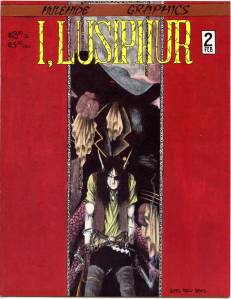
I, Lusiphur (December 1991 – December 1992) – Poison Elves (February 1993 – February 1995) Hayes originally self-published the series during the early 90s under his company Mulehide Graphics under the title of I, Lusiphur. The title was changed to Poison Elves because the similarity of Lusiphur to Lucifer led to the misconception that the series was Satanic in nature. Sales were reported to have increased significantly after the name change. Drew claimed in one of his Starting Notes that the name change was prompted by a letter from a teen-aged fan whose mother had thrown out his comics after finding I, Lusiphur comics amongst his collection.
The first ten issues of the Mulehide series were published in a larger magazine size format.
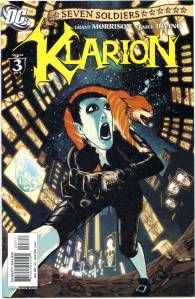
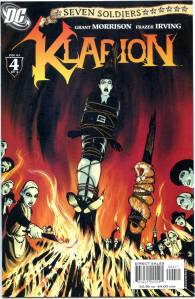
Grant Morrison is joined by artist Frazer Irving for the tale of Klarion! Deep in the bowels of a subterranean city, young dissenter Klarion has been handpicked to join the Submissionary Order, a group made up of brutal lawgivers who maintain order with the help of their familiars.
Man-Thing’s solo title ran 22 issues (Jan. 1974 – Oct. 1975). Following Morrow, the main series’ primary pencillers were, successively, Val Mayerik, Mike Ploog, John Buscema, and Jim Mooney. A sister publication was the larger, quarterly Giant-Size Man-Thing #1-5 (August 1974 – August 1975), which featured 1950s horror-fantasy and 1960s science fiction/monster reprints as back-up stories, with a Howard the Duck feature added in the final two issues. The unintentional double entendre in the sister series’ title became a joke among comics readers.
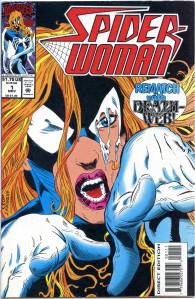
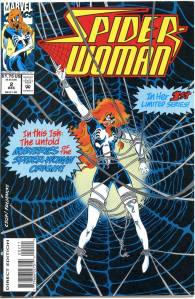
While she frequently appears as a member of a team, such as the Avengers West Coast and Force Works, Julia Carpenter starred in her own four-part Spider-Woman miniseries which explained her origin and the origin of her enemies, Death Web. As Spider-Woman, Carpenter has appeared as a starring character in Avengers West Coast and Force Works as well as a supporting character in the third Spider-Woman series, whose main character was Mattie Franklin.
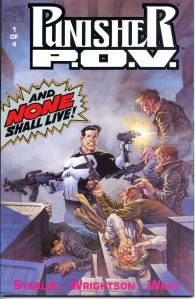
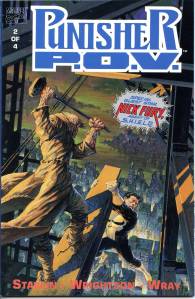
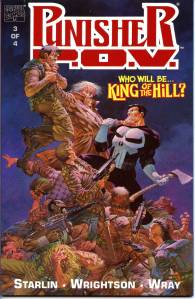
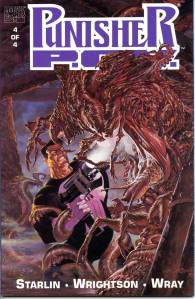
The four-issue series revolves around the Punisher hunting down a former 1960s radical who was released from prison only to be horribly disfigured when a bomb he and his friend were working on exploded. After exposure to toxic waste, the disfigured radical becomes almost unkillable due to the chemicals mutating him, giving him an accelerated healing factor.
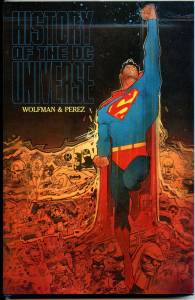
History of the DC Universe was an attempt to summarize the new history of the DC Universe to establish what was canonical after Crisis reformed the multiverse into a single universe.In the original planning of Crisis on Infinite Earths, the History would have formed the final two issues, following the destruction of the Multiverse at the Beginning of Time, but this was changed. History of the DC Universe had been one of the working titles for Crisis on Infinite Earths.
The loose plotline of the series involves the character Harbinger chronicling the past, present, and future of the post-Crisis DC Universe. The history is mostly told through one- and two-page splash pages, accompanied by brief prose. At the end of the series, Harbinger places the history in a capsule and launches it into space. In the subsequent series Millennium, this history is intercepted by the Manhunters and used against Earth’s superheroes.
The series was reprinted in hardcover by Graphitti Designs in 1988 with a painted cover by Bill Sienkiewicz. It featured additional material not included in the original series including an introduction by Wolfman and the following:
The series was reprinted as a trade paperback in 2002. It had a new cover painting by Alex Ross but did not include the bonus material from the 1988 hardcover edition.
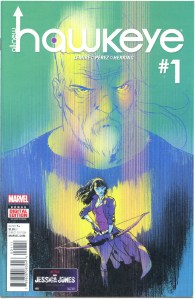
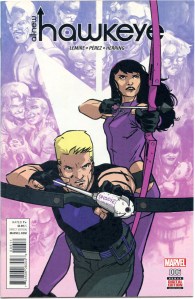
Hawkeye and Hawkeye take aim at another season. But it’s not all straight as an arrow for Clint and Kate. A deep-seated rift that stretches across time, brings old man Clint and a wiser Kate back together as they chase down mistakes from their past. The team of Jeff Lemire and Ramon Perez return, bringing you another inspired look at the world of Hawkeye.
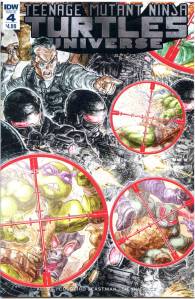
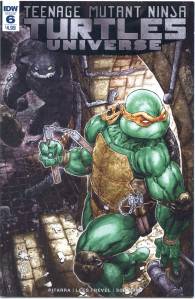
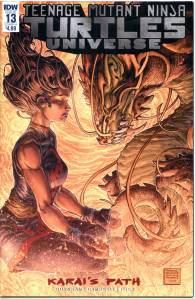
A spin-off series similar to Mirage’s Tales of the Teenage Mutant Ninja Turtles, which started publication on August 31, 2016. It serves as a narrative expansion to the main series with the introduction of crucial sideplots and additional characters. The series ended after 25 issues in August 2018.
The Turtles cross over with Kaniugas popular character Creed, as they did with many indy comics characters in their pre-Nickelodeon heyday. Transported to the realm of the imagination by a dream stone, the Turtles must join forces with teen Mark Farley, aka Creed, to battle an alien adversary named Shrapnel and discover what’s really going on.
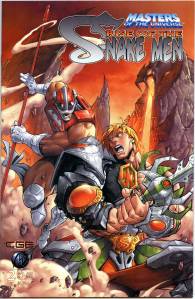
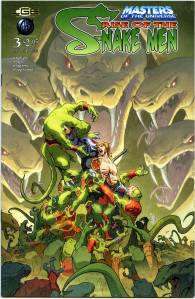
Masters of the Universe: Rise of the Snake Men is a three-issue miniseries originally published by CrossGen in 2003 and 2004. It was written by Val Staples and illustrated by Andie Tong and Jonboy Meyers. Here, King Hsss is freed from his ancient prison and unleashes his army on Eternia.
Masters of the Universe – Rise of the Snake Men #1 VF-NM $8
Masters of the Universe – Rise of the Snake Men #2 VF-NM $6
Masters of the Universe – Rise of the Snake Men #3 VF-NM $5



 EHT Comics