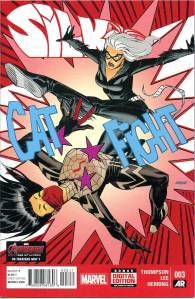
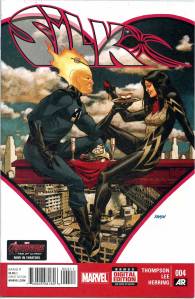
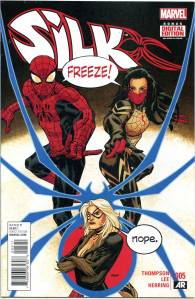
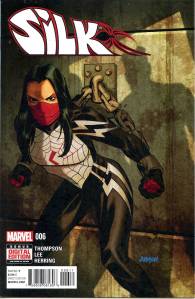
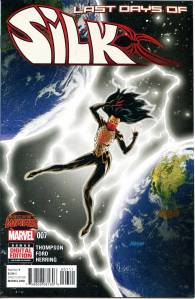
Silk V1 (2015)

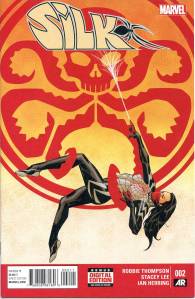
Silk first appeared in The Amazing Spider-Man #1 (April 2014) as a faceless cameo and was created by writer Dan Slott and artist Humberto Ramos. She made several other faceless appearances throughout the volume’s first story arc, before making her full debut in The Amazing Spider-Man #4 (July 2014), as part of a tie-in to the “Original Sin” storyline. An ongoing title featuring Silk started publishing in February 2015, with scripts by Supernatural writer Robbie Thompson and art by Stacey Lee. Silk volume 1 came to an end during the Secret Wars event. After the event, a second volume began which concluded on issue #19.

Giant-Size Spider-Man (1974)

Part of the “Giant-Size” format that Marvel published from 1974 to 1976 that featured comics that were much larger than other Spider-Man books at the time and had multiple stories, with the second one usually being a reprint of an earlier Spider-Man story.

Man-Thing V2 (1979)

A second Man-Thing series ran 11 issues (Nov. 1979 – Jan. 1981). Writer Michael Fleisher and penciller Mooney teamed for the first three issues, with the letters page of #3 noting that Fleisher’s work had received a great deal of negative criticism and that he had been taken off the book. He was succeeded by, primarily, writer Chris Claremont and illustrators Don Perlin (breakdowns) and Bob Wiacek (finished pencils). Claremont’s stories introduced the Man-Thing and Jennifer Kale to Doctor Strange (whose series he was concurrently writing), after which his material focused on two new supporting characters: John Daltry, Citrusville’s new sheriff, and Bobbie Bannister, a formerly wealthy girl who is the only survivor when her parents’ yacht is attacked. These characters’ stories he resolved by tying them to a resolution for his own War Is Hell series.


Power Records (1974)

Power Records was a record label, featuring characters licensed from DC Comics and Marvel Comics, and contemporary movies and television series (such as KojakPlanet of the ApesThe Six Million Dollar ManSpace: 1999, and Star Trek), in stories geared toward older children. The book-and-record sets frequently featured original 20-page comic books along with an extended-play 7″ record of the story. Playing the record while reading along in the book brought the story to life through music and sound effects. There were also other 7″ single releases. Besides book-and-record sets, LPs were produced, featuring the recorded stories without illustrations. As of 2010, none of the Power Records material has been re-released for CD or digital media due to copyright issues.

She Hulk V2 (2005)

With the original creative team (Dan Slott and Juan Bobillo) from the previous series, the book returned eight months later as promised in October 2005. The third issue was billed as the 100th issue of a She-Hulk comic book, and had story art by numerous artists, including Vosburg. There was no new artwork by Buscema or Byrne, who were represented by reprints of Sensational She-Hulk #1 and Savage She-Hulk #1.

Dan Slott’s last issue is #21; with 33 issues, Slott has written the most solo issues of She-Hulk. Peter David became the new writer with She-Hulk #22. Marvel Comics announced that She-Hulk #38 (February 2009) would be the final issue of the series. Peter David commented on his blog that sales of the book were hurt due to discrepancies between his book and Jeph Loeb‘s Hulk series, caused by editorial error.

The Infinity Crusade (1993)

Infinity Crusade is a six-issue limited series published by Marvel Comics in 1993. The series was written by Jim Starlin and penciled by Ron Lim, Ian Laughlin, Al Milgrom and Jack Morelli.

It is a sequel to Infinity Gauntlet and Infinity War, both from the same creative team.

When hero Adam Warlock takes possession of the artifact the Infinity Gauntlet, he expels the good and evil aspects of his being to become a totally logical being, who can therefore use the Gauntlet wisely. This act not only freed the incarnation of his evil aspects, Warlock’s old foe the Magus, but also created an incarnation of his good aspects, the Goddess. During the events of the Infinity War, the Goddess steals the five cosmic containment units (also known as Cosmic Cubes) collected by the Magus. She eventually collects a total of thirty, and uses these to form a “Cosmic Egg” capable of fulfilling wishes.

Venom: First Host (2018)

Tel-Kar first appeared in Venom: First Host #1. During the Kree-Skrull War, the Kree, desiring to replicate the Skrull‘s shape-shifting abilities, they obtain the newborn Venom, which had been outcast from the other symbiotes, on Gorr‘s planet where Knull had created the symbiotes. Tel-Kar is recruited to be bonded to the newborn symbiote in order to infiltrate the Skrull army. Tel-Kar’s body is biologically altered so he can have full control over the symbiote’s mind to the point of erasing its memories. He successfully infiltrated the Skrull army discovering various secrets. However he blew his cover up in order to save some Kree refugees and handed the symbiote to them to return it to Hala. Then Tel-Kar was betrayed by Ronan the Accuser who used a Kree Sentry to capture Tel-Kar and was given to the Skrulls as a war criminal. Separated from Tel-Kar after his capture, the symbiote goes on to be bonded to Spider-Man.

X-Men #1 (1991) Best Selling Comic Retailer Promo Holograms

The Gold Hologram of X-Men #1 1991 cover was awarded for every 500 copies of X-men #1 ordered by retailers.

Origin (2001)

Origin (alternatively known as Wolverine: Origin or Origin: The True Story of Wolverine) is a six-issue comic book limited series published by Marvel Comics from November 2001 to March 2002, written by Bill JemasJoe Quesada and Paul Jenkins, and illustrated by Andy Kubert (pencils) and Richard Isanove (color).

Origin tells the story of the superhero Wolverine, best known as a member of the X-Men. Since the character first appeared in the early 1970s his history had often been shrouded in mystery, with bits of information revealed piecemeal over time (notably in Weapon X), but this series was the first to reveal Wolverine’s early days and his original background. In their introductions, some of those who worked on the series express their reluctance to reveal the actual origins of one of the comic world’s most popular and mysterious characters. Even Wolverine himself has few recollections of where he came from and this was an essential part of his appeal.


Venom Vs. Carnage (2004)

In Venom vs. Carnage #1-4, the Carnage symbiote reproduces, with Kasady implanting a spawn of it into Patrick “Paddy” Mulligan, an Irish-American police officer who was recently married and expecting a child. Mulligan became Toxin—who single-handedly overpowered both Venom and Carnage. Nevertheless, Mulligan remained determined to use his new-found powers for good—learning as much as he can from Spider-Man—while leaving behind his wife and newborn son in order to protect them from danger.