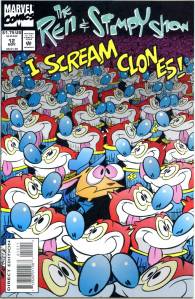
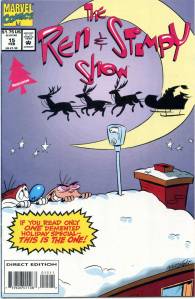
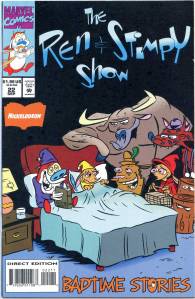
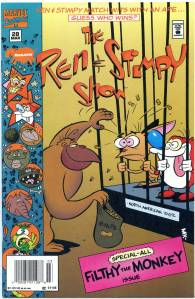
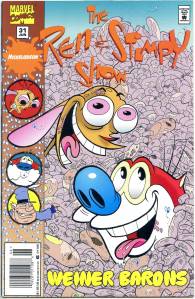
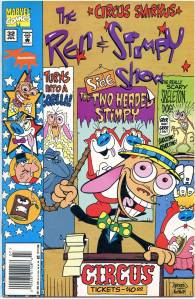
Marvel Comics optioned the rights to produce comic books based on Nickelodeon properties in 1992. The initial plan was to have an anthology comic featuring several Nicktoons properties. Marvel produced 44 issues of the ongoing series, along with several specials under the Marvel Absurd imprint. Most of these were written by comic scribe Dan Slott. One Ren & Stimpy special #3, Masters of Time and Space, was set up as a ‘Choose Your Own Adventure‘ and with a time travel plot, took Slott six months to plot out in his spare time. It was designed so that it was possible to choose a path that would eventually be 20 pages longer than the comic itself. Issue #6 of the series starred Spider-Man battling Powdered Toast Man. The editors named the “Letters to the Editor” section “Ask Dr. Stupid”, and at least one letter in every column would be a direct question for Dr. Stupid to answer. This comic series lasted from December 1992-July 1996.
Category: Marvel Iron Age
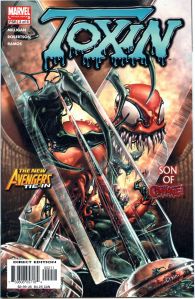
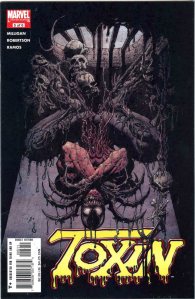
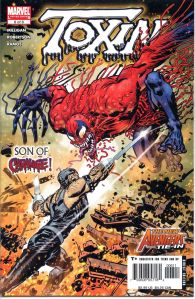
Toxin (2005)
Toxin or the Toxin symbiote is the third major symbiote of the Spider-Man series, the ninth known to have appeared in the comics outside of the Planet of the Symbiotes storyline, and the first symbiote that Spider-Man considers an ally, despite temporary alliances with Venom on numerous occasions. The first host of the Toxin symbiote is former NYPD police officer Patrick Mulligan. Toxin later bonded to Eddie Brock as his second host after Patrick Mulligan was killed.
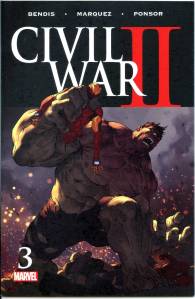
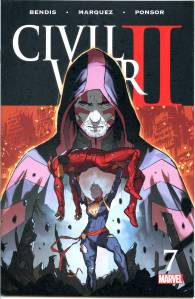
Civil War II (2016)
Civil War II, which debuted in June 2016, is a sequel to the 2006 “Civil War” storyline.
A new Inhuman, with the ability to profile the future, emerges and the ramifications ripple into every corner of the Marvel Universe. Lines are drawn, bodies fall, and the Marvel Universe will be rocked to it’s very core.
Incredible Hulk V2 (2000’s)
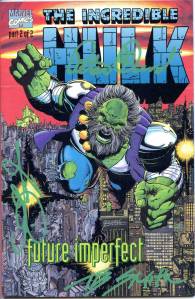
In 2000, Banner and the three Hulks (Savage Hulk, Grey Hulk, and the “Merged Hulk”, now considered a separate personality and referred to as the Professor) become able to mentally interact with one another, each personality taking over the shared body as Banner began to weaken due to his suffering from Lou Gehrig’s disease. During this, the four personalities (including Banner) confronted yet another submerged personality, a sadistic “Devil” intent on attacking the world and attempting to break out of Banner’s fracturing psyche, but the Devil was eventually locked away again when the Leader was able to devise a cure for the disease using genes taken from the corpse of Brian Banner. In 2005, it is revealed that the Nightmare has manipulated the Hulk for years, and it is implied that some or all of the Hulk’s adventures written by Bruce Jones may have been just an illusion.
In 2006, the Illuminati decide the Hulk is too dangerous to remain on Earth and send him away by rocket ship which crashes on Planet Sakaar ushering in the “Planet Hulk” storyline that saw the Hulk find allies in the Warbound, and marry alien queen Caiera, a relationship that was later revealed to have born him two sons: Skaar and Hiro-Kala. After the Illuminati’s ship explodes and kills Caiera, the Hulk returns to Earth with his superhero group Warbound and declares war on the planet in World War Hulk (2007). However, after learning that Miek, one of the Warbound, had actually been responsible for the destruction, the Hulk allows himself to be defeated, with Banner subsequently redeeming himself as a hero as he works with and against the new Red Hulk to defeat the new supervillain team the Intelligencia.
Black Panther V5 (2009)
Attacked by the forces of fellow Cabal member Doctor Doom, T’Challa is left comatose. His sister Shuri is trained as the next Panther, with the mantle passing onto her officially after T’Challa awakens from his coma and attempts to recover from his injuries.
In the aftermath, T’Challa loses all of his enhanced attributes given to him by being the panther totem. As a result, he works with his sorcerer, Zawavari, to accumulate a replacement. He has since made a pact with another unknown Panther deity, returning his attributes to an even higher level as well as placing incantations on his body, making himself highly resistant to most magic and mystic assaults. This has all been done in preparation for the imminent battle with Doctor Doom, which culminated in T’Challa rendering all of the processed vibranium inert to give his people a chance to rebuild without their dependence on the element.
Moebius – Epic Graphic Novels (1987)
The Moebius pseudonym, which Jean Giraud came to use for his science fiction and fantasy work, was born in 1963. In a satire magazine called Hara-Kiri, Giraud used the name for 21 strips in 1963–64. Subsequently, the pseudonym went unused for a decade.
In 1975 he revived the Moebius pseudonym, and with Jean-Pierre Dionnet, Philippe Druillet, and Bernard Farkas, he became one of the founding members of the comics art group “Les Humanoides Associes”. Together they started the magazine Métal Hurlant, the magazine known in the English speaking world as Heavy Metal . Moebius’ famous serial The Airtight Garage and his groundbreaking Arzach both began in Métal Hurlant.] In 1976 Metal Hurlant published “The Long Tomorrow” written by Dan O’Bannon.
Arzach is a wordless comic, created in a conscious attempt to breathe new life into the comic genre which at the time was dominated by American superhero comics. It tracks the journey of the title character flying on the back of his pterodactyl through a fantastic world mixing medieval fantasy with futurism. Unlike most science fiction comics it has no captions, no speech balloons and no written sound effects. It has been argued that the wordlessness provides the strip with a sense of timelessness, setting up Arzach’s journey as a quest for eternal, universal truths.
His series The Airtight Garage is particularly notable for its non-linear plot, where movement and temporality can be traced in multiple directions depending on the readers own interpretation even within a single planche (page or picture). The series tells of Major Grubert, who is constructing his own universe on an Asteroid named fleur, where he encounters a wealth of fantastic characters including Michael Moorcock‘s creation Jerry Cornelius.
In 1980 he started his famous L’Incal series in collaboration with Alejandro Jodorowsky. From 1985 to 2001 he also created his six-volume fantasy series Le Monde d’Edena, portions of which appeared in English as The Aedena Cycle.
In his later life, Giraud decided to revive the Arzak character in an elaborate new adventure series; the first volume of a planned trilogy, Arzak l’arpenteur, appeared in 2010. He also added to the Airtight Garage series with a new volume entitled Le chasseur déprime.
Edge of Spiderverse (2022)
The end of the spider-verse is coming! edge (‘ej) noun – 1. outermost limit of an object – 2. the sharp side of a blade. The leading edge of the Spider-Verse brought you Spider-Gwen and Peni Parker. This final edge will introduce you to some of the most important characters in the future of the Spider-Verse…but it will also slice the final strand of the web.
Marvel Team-Up V3 (2005)
Comics journalist Jonathan Miller summarized Marvel Team-Up in a retrospective article:
“The series was admittedly formulaic; either Spider-Man or that issue’s guest-star would encounter a menace and then by sheer chance cross paths with another hero who would lend a hand. The title’s guest-stars were an equal mix of A-list characters whose presence was likely to increase sales and fledgling heroes being given exposure in the hopes of launching them into stardom but who for the most part continued to languish in obscurity.”
The third Marvel Team-Up series launched in January 2005 and ran for 25 issues which starred a variety of characters.
Superior Spider-Man V1 (2013)
The series was written by Dan Slott with artwork by Ryan Stegman, Humberto Ramos, and Giuseppe Camuncoli. The storyline sees a dying Otto Octavius swapping bodies with Peter Parker and allowing Parker to die in his body. However, he later learns about responsibility and redeems himself. Adopting the alias “Superior Spider-Man”, he becomes a superhero and is determined to prove himself as a better Spider-Man than Parker ever was, and a better man than Octavius.
Thunderbolts V1 (1997)
Soon after the publication of The Incredible Hulk #449, the team’s own series premiered. The first issue, cover dated April 1997, was played largely as a straight superhero story, until the revelation of the Thunderbolts’ true nature on the last page of the comic. This is considered one of the most well-conceived plot twists in the history of American comic books, with Wizard magazine readers voting it “Comics’ Greatest Moment of 1997” and later, in 1999, placing it at #11 on a list of “The 25 Greatest Comic Moments Ever”. Marvel managed to keep the secret of the Thunderbolts’ true villainous identities tightly under wraps before the book launched. When word got out, the first issue sold out so quickly that Marvel not only offered a second printing, but also did a “mini-trade paperback” collecting the first two issues. Fabian Nicieza replaced Busiek in issue #34. Patrick Zircher, after a couple of fill-ins, replaced Bagley in issue #51.