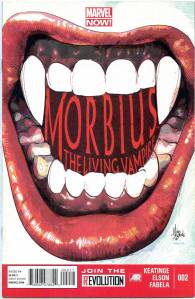
The ALL-NEW Michael Morbius? Morbius, is back, but on the run and desperate to quell his vampiric tendencies. But has the midnight son really changed? As Morbius tries to stay under the radar, a new threat arises, and they want Morbius dead.
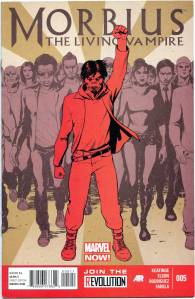
The ALL-NEW Michael Morbius? Morbius, is back, but on the run and desperate to quell his vampiric tendencies. But has the midnight son really changed? As Morbius tries to stay under the radar, a new threat arises, and they want Morbius dead.
In 1997, Deadpool was given his own ongoing title, initially written by Joe Kelly, with then-newcomer Ed McGuinness as an artist. Deadpool became an action comedy parody of the cosmic drama, antihero-heavy comics of the time. The series firmly established his supporting cast, including his prisoner/den mother Blind Al and his best friend Weasel. The ongoing series gained cult popularity for its unorthodox main character and its balance of angst and pop culture slapstick and the character became less of a villain, though the element of his moral ambiguity remained. The writer Joe Kelly noted, “With Deadpool, we could do anything we wanted because everybody just expected the book to be cancelled every five seconds, so nobody was paying attention. And we could get away with it.”
The series was taken over by Christopher Priest who noted that he found Kelly’s issues to be “complex and a little hostile to new readers like me” and that by issue 37, he realized that “it was okay to make Deadpool look stupid.”


Darth Maul’s time as apprentice to Darth Sidious has long been cloaked in shadows, but at last his tale of revenge will be reveled. From writer Cullen Bunn and artist Luke Ross comes a tale of rage unleashed as Darth Maul prepares for his first encounter with the Jedi.

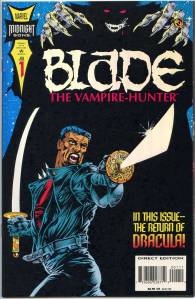
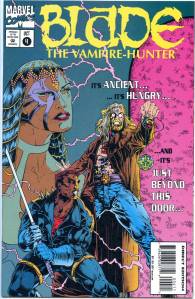
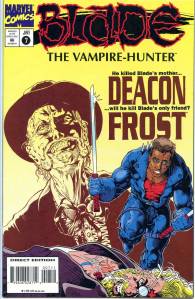
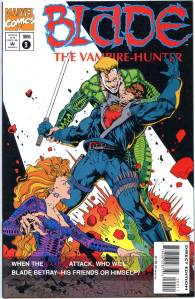
Following the cancellation of Nightstalkers, Blade debuted in his first color-comics series, Blade: The Vampire Hunter #1–10 (July 1994 – April 1995), written by Ian Edginton (with the last two issues by Terry Kavanagh) and penciled by Doug Wheatley.




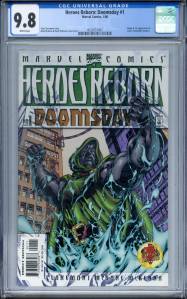
In the years after the Heroes Reborn event, Marvel published a series of one-shots that revisit the pocket universe created by Franklin Richards. These can be read in any order and even touch on some characters who were not featured in the original storyline.
Avengers A.I. was an ongoing comic book series published by Marvel Comics that was released in July 2013, as part of the company’s Marvel NOW! initiative. The series takes place after the events of Age of Ultron, where the world has been colonized by A.I.s “who may or may not have positive feelings about the way humanity has been treating them for the past 100 years.” The series ended in April 2014.

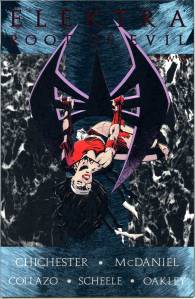
Created by Frank Miller, Elektra first appeared in Daredevil #168 (January 1981). Miller originally intended this issue, which was essentially a filler story, to be Elektra’s only appearance, but she instead became a frequently appearing villain in Daredevil until her death in issue #181 (April 1982). She was resurrected shortly after, but the story contained a narrative note which indicated that Daredevil would never encounter her again.
After over a decade’s absence, she reappeared in Daredevil #324-327 (January–April 1994), and went on to a brief stint as a supporting character in Wolverine (in #100-106). Daredevil writer D. G. Chichester recounted that he and editor Ralph Macchio had
bandied about the idea [of bringing back Elektra] in a casual fashion now and again, but neither of us wanted to do it as a gimmick. On the rare occasion I thought I had a legitimate angle to use her, Ralph was cool to the idea. But as we geared up for what would become Fall From Grace, Ralph out of the blue said, “What about bringing back Elektra?” — and it was really the missing piece that clicked together all the loose pieces of the story in my head, and became the nexus for everything tying together as well as it did. In my mind, it’s always been her to whom the title refers.
This upset Frank Miller, who claimed that Marvel had previously promised him that the character would not be used in any publication. She has since appeared in two eponymous ongoing series and several mini-series.



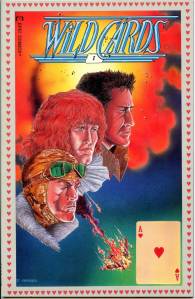
Wild Cards is a four-part comic book series covering events in the Wild Cards anthology. It recounts events previously published in print in novel format, and ties them all together in a story pitting Jay Ackroyd against the machinations of a mystery bomber.
First published in 1990 by Marvel Comics under the Epic Comics imprint Wild Cards ran from September to December of 1990.

In 2019, a 5 part mini-series titled Silver Surfer: Black was released featuring art from Tradd Moore in collaboration with writing from Donny Cates. The series is an extension of a Guardians of the Galaxy storyline which the Surfer was sucked into a black hole and ejected into unfamiliar space territory. This run follows the Surfer as he traverses the spaceways on a journey back home.


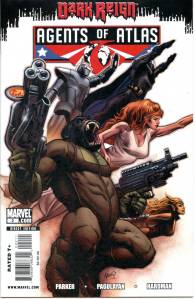
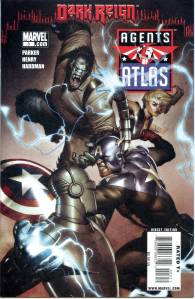
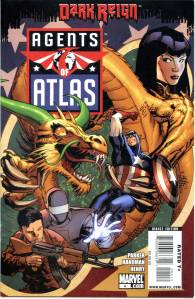
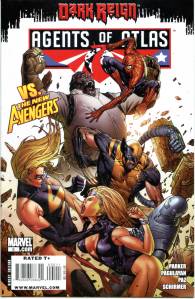
The heroes of the 1950s are back with big plans for the 21st Century! When Federal enforcers under the hand of Norman Osborn burst into an armory under the control of the Atlas Foundation, Jimmy Woo’s Agents go head-to-head with the new powers that be. How it all goes down will make the playing field of the modern Marvel Universe more volatile than ever!