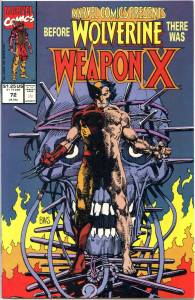
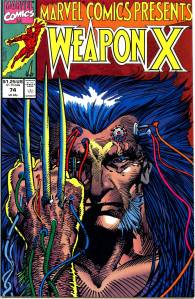
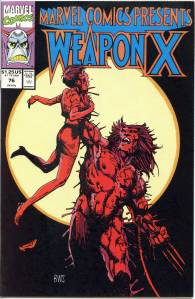
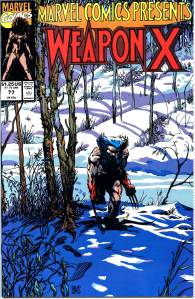
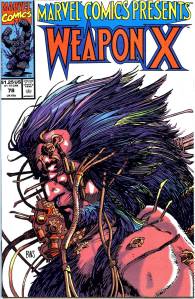
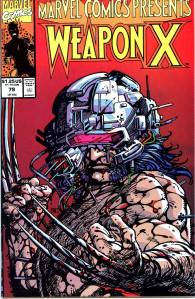
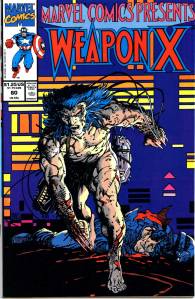
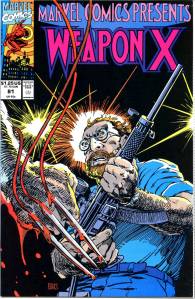
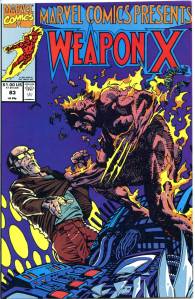
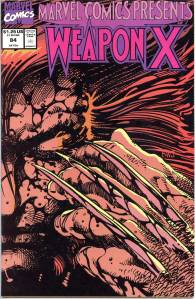
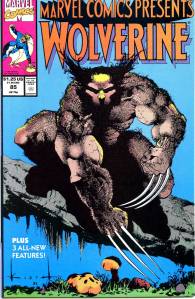
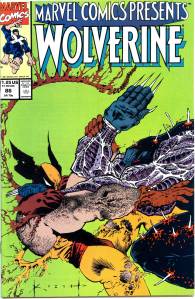
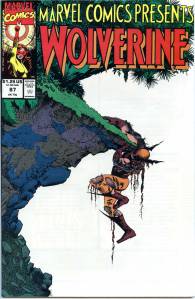
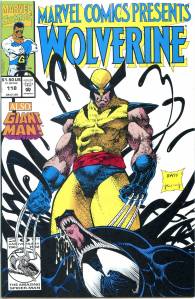
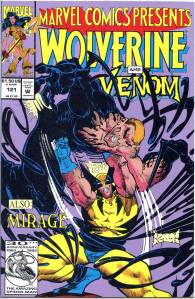
Marvel Comics Presentswas published from 1988 to 1995. The original plan was for the lead story to feature different members of the X-Men in solo adventures lasting between eight and ten episodes. The first ten issues featured Wolverine; others featured were Colossus, Cyclops, Havok, and Excalibur. From issue 39 onwards,Wolverine was featured as the lead story in all issues. Particularly notable was “Weapon X” in issues #72-84, which revealed Wolverine’s origin, with story and art by Barry Windsor-Smith.
Steve Gerber’s posthumous Man-Thing story “The Screenplay of the Living Dead Man”, with art by Kevin Nowlan, originally planned as a 1980s graphic novel before being left uncompleted by the artist, was revived in the 2010s and appeared as a three-issue miniseries cover-titled The Infernal Man-Thing (Early Sept.-Oct. 2012). The story was a sequel to Gerber’s “Song-Cry of the Living Dead Man” in Man-Thing #12 (Dec. 1974).
Amazing Spider-Man reverted completely to its original numbering for #500 (Dec. 2003).Mike Deodato, Jr. penciled the series from mid-2004 until 2006. That year Peter Parker revealed his Spider-Man identity on live television in the company-crossover storyline “Civil War“, in which the superhero community is split over whether to conform to the federal government’s new Superhuman Registration Act. This knowledge was erased from the world with the event of the four-part, crossover story arc, “One More Day“, written partially by J. Michael Straczynski and illustrated by Joe Quesada, running through The Amazing Spider-Man #544-545 (Nov.-Dec. 2007), Friendly Neighborhood Spider-Man #24 (Nov. 2007) and The Sensational Spider-Man #41 (Dec. 2007), the final issues of those two titles. Here, the demonMephisto makes a Faustian bargain with Parker and Mary Jane, offering to save Parker’s dying Aunt May if the couple will allow their marriage to have never existed, rewriting that portion of their pasts. This story arc marked the end of Straczynski’s tenure as writer.
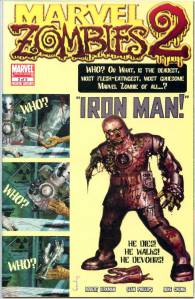
Forty years have passed and the zombies have come back home after eating just about everything else in the universe. Yum yum! What awaits them back on Earth, though, is beyond anything even these shambling monstrosities could have conceived! This is a new series featuring the amazing, irreverent take on the Marvel characters that became last year’s unexpected smash hit. They’re back and more stomach-churning than ever! The smash hit series is back, daring to ask: “Whose stomach are you in?”
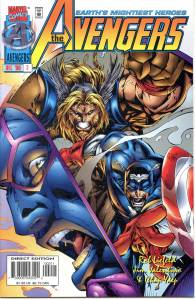
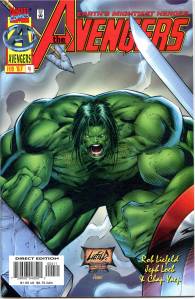
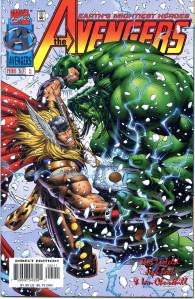
During the “Heroes Reborn” event, many of the Avengers together with the Fantastic Four and others, died trying to stop the psychic entity Onslaught, although it was revealed that Franklin Richards preserved those heroes in a pocket universe. Believing the main team to be gone, the Black Widow disbanded the Avengers, and only butler Edwin Jarvis remained to tend to the Mansion.
The previous continuity of the Marvel Universe was set aside as the heroes were “reborn” in the pocket universe created by Franklin Richards to save his parents and their friends, while the “Heroes Reborn” line ended and the heroes returned to the prime Marvel Universe. This restoration also undid recent changes to the team members such as the Wasp being mutated into an insectoid form, Hawkeye being rendered deaf, and Stark being replaced by his teenage self, attributed to Franklin’s childish perception recreating the heroes in the manner he was more familiar with.
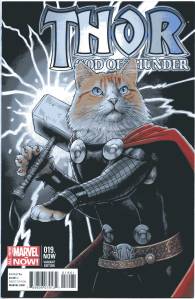
In October 2012, Thor became a regular character in Uncanny Avengers, beginning with issue #1. The following month, an ongoing series titled Thor: God of Thunder by writer Jason Aaron and artist Esad Ribić debuted as part of the Marvel NOW! relaunch.[49][50] This story arc was voted as the 8th best Thor story by Comicbook.com.
Simon eventually took a break from being an Avenger to concentrate on his acting career. He desired to build a normal life for himself and to come to terms with who he was. In particular he wondered what kind of person he truly was and whether or not he was truly human, given his transformation into ionic energy.
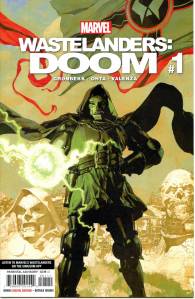
The Once and Future King! Doctor Doom helped wipe out the heroes on the Day the Villains Won, but even as he rules his domain in the Wastelands, a greater destiny calls to him. When a mysterious power blocks his oversight of a particular region, what he discovers will have ripple effects across the Wastelanders stories!