Marvel’s series of Star Trek comics began in 1979 with an adaptation of Star Trek: The Motion Picture and continued for another two years. These tales take place during a second five-year mission of Kirk and the Enterprise that would have been featured in the never-produced Star Trek: Phase II TV series. Marvel’s license from Paramount prohibited them from using concepts introduced in the original series. They were only allowed to use the characters and concepts from Star Trek: The Motion Picture. The series lasted 18 issues and ended in 1981.
Category: Marvel Bronze Age
The Defenders V1 (1970’s)
The Defenders had a rotating line-up from 1972 until 1986, with Dr. Strange and the Hulk being more or less constant members along with a number of other mainstays such as Valkyrie, Nighthawk, Hellcat, the Gargoyle, Beast, the Son of Satan and Luke Cage, and a large number of temporary members. The publication was retitled near the end of the run as The New Defenders but featured none of the original members and only Valkyrie, the Beast and the Gargoyle of the former long-term members. The concept was modified in the 1993–95 series Secret Defenders, in which Dr. Strange assembled different teams for each individual mission. Later, the original team were reunited in a short-lived series by Kurt Busiek and Erik Larsen. In the 2000s, Marvel published a new miniseries featuring the classic line-up. Writer Matt Fraction and artist Terry Dodson launched a new Defenders series in December 2011.
Skull the Slayer (1975)
Jim Scully was an adventurer whose plane went through a time warp in the Bermuda Triangle, marooning him and three companions in an alternate Earth where dinosaurs, primitives, and aliens co-existed. Scully and his three companions were eventually rescued and returned to their own world by the Thing of the Fantastic Four. He served in Doctor Druid‘s team of occult investigators the Shock Troop, alongside Sepulchre and N’Kantu, the Living Mummy.
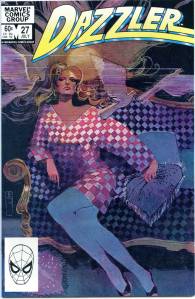
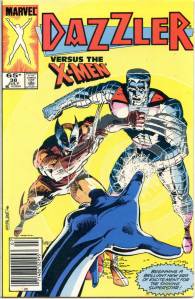
Dazzler (1981)
A mutant with the ability to convert sound vibrations into light and energy beams, Dazzler was developed as a cross-promotional, multi-media creation between Casablanca Records and Marvel Comics until the tie-ins were dropped in 1980. The character was created by a committee of Marvel staff, principally writer/editor Tom DeFalco and illustrator John Romita Jr.
Despite the fact that Dazzler was commissioned as a disco singer, the character shifted to other musical genres, including rock and adult contemporary. She starred in a self-titled series in the early 1980s which lasted forty-two issues, a Marvel Graphic Novel titled Dazzler: The Movie, a four-issue limited series co-starring The Beast titled Beauty and the Beast, and later joined the cast of the X-Men. She was briefly a member of the spin-off group Excalibur but has since re-joined the X-Men.
Giant-Size Chillers V1 (1974)
Only issue. Becomes Giant-Size Dracula with issue #2. Origin and 1st appearance of Lilith (Dracula’s daughter) in a new Dracula story, “Night of the She-Demon.” Script by Marv Wolfman, pencils by Gene Colan, inks by Frank Chiaramonte. Two-page text history of Dracula in Marvel Comics by Wolfman. Also contains the following reprints: “Have You Ever Seen a Huge, Black Vampire” (script by Stan Lee, art by John Romita Sr. from Mystic 25); “The Village Graveyard” (art by Russ Heath from Weird Worlds 4). Cover by John Romita.
Man-Thing V1 (1974)
Man-Thing’s solo title ran 22 issues (Jan. 1974 – Oct. 1975). Following Morrow, the main series’ primary pencillers were, successively, Val Mayerik, Mike Ploog, John Buscema, and Jim Mooney. A sister publication was the larger, quarterly Giant-Size Man-Thing #1-5 (August 1974 – August 1975), which featured 1950s horror-fantasy and 1960s science fiction/monster reprints as back-up stories, with a Howard the Duck feature added in the final two issues. The unintentional double entendre in the sister series’ title became a joke among comics readers.
Giant-Size Spider-Man (1974)
Part of the “Giant-Size” format that Marvel published from 1974 to 1976 that featured comics that were much larger than other Spider-Man books at the time and had multiple stories, with the second one usually being a reprint of an earlier Spider-Man story.
Man-Thing V2 (1979)
A second Man-Thing series ran 11 issues (Nov. 1979 – Jan. 1981). Writer Michael Fleisher and penciller Mooney teamed for the first three issues, with the letters page of #3 noting that Fleisher’s work had received a great deal of negative criticism and that he had been taken off the book. He was succeeded by, primarily, writer Chris Claremont and illustrators Don Perlin (breakdowns) and Bob Wiacek (finished pencils). Claremont’s stories introduced the Man-Thing and Jennifer Kale to Doctor Strange (whose series he was concurrently writing), after which his material focused on two new supporting characters: John Daltry, Citrusville’s new sheriff, and Bobbie Bannister, a formerly wealthy girl who is the only survivor when her parents’ yacht is attacked. These characters’ stories he resolved by tying them to a resolution for his own War Is Hell series.
Power Records (1974)
Power Records was a record label, featuring characters licensed from DC Comics and Marvel Comics, and contemporary movies and television series (such as Kojak, Planet of the Apes, The Six Million Dollar Man, Space: 1999, and Star Trek), in stories geared toward older children. The book-and-record sets frequently featured original 20-page comic books along with an extended-play 7″ record of the story. Playing the record while reading along in the book brought the story to life through music and sound effects. There were also other 7″ single releases. Besides book-and-record sets, LPs were produced, featuring the recorded stories without illustrations. As of 2010, none of the Power Records material has been re-released for CD or digital media due to copyright issues.
The Son of Satan (1975)
During the “Son of Satan” run, Marvel Spotlight was a controversial series, with numerous readers writing to object to the depictions of Satanism and Wiccanism as being either inaccurate or furthering the cause of evil. Nonetheless, sales were strong, prompting Marvel to launch the character into his own series, Son of Satan, written by John Warner. The character’s success faded soon after the series launch, and Son of Satan was cancelled with issue #7, though an unused fill-in was published as Son of Satan #8 (Feb. 1977).