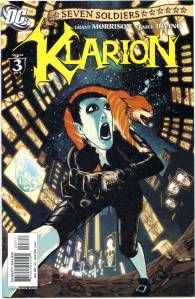
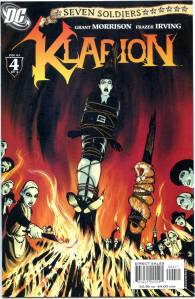
Grant Morrison is joined by artist Frazer Irving for the tale of Klarion! Deep in the bowels of a subterranean city, young dissenter Klarion has been handpicked to join the Submissionary Order, a group made up of brutal lawgivers who maintain order with the help of their familiars.
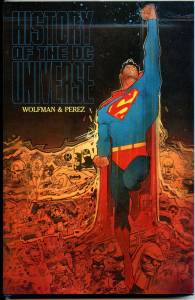
History of the DC Universe was an attempt to summarize the new history of the DC Universe to establish what was canonical after Crisis reformed the multiverse into a single universe.In the original planning of Crisis on Infinite Earths, the History would have formed the final two issues, following the destruction of the Multiverse at the Beginning of Time, but this was changed. History of the DC Universe had been one of the working titles for Crisis on Infinite Earths.
The loose plotline of the series involves the character Harbinger chronicling the past, present, and future of the post-Crisis DC Universe. The history is mostly told through one- and two-page splash pages, accompanied by brief prose. At the end of the series, Harbinger places the history in a capsule and launches it into space. In the subsequent series Millennium, this history is intercepted by the Manhunters and used against Earth’s superheroes.
The series was reprinted in hardcover by Graphitti Designs in 1988 with a painted cover by Bill Sienkiewicz. It featured additional material not included in the original series including an introduction by Wolfman and the following:
The series was reprinted as a trade paperback in 2002. It had a new cover painting by Alex Ross but did not include the bonus material from the 1988 hardcover edition.
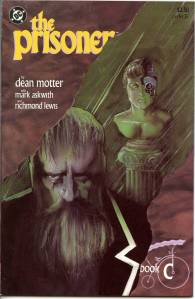
The Prisoner: Shattered Visage is a four-issue mini-series published in 1988 and based on The Prisoner, the 1967 television series starring Patrick McGoohan. The name is a reference to Percy Shelley‘s famous poem Ozymandias, which forms part of the introduction.
Set twenty years after the final episode of the television series, Shattered Visage follows former secret agent Alice Drake as she is shipwrecked on the shores of the Village and encounters an aged, psychologically scarred Number Six. While the decades-old conflict unfolds between Six and Number Two (as played by Leo McKern in the TV series), secret agents in London have their own plans regarding the intelligence mine that is The Village, as well as the secret lying at its very core.
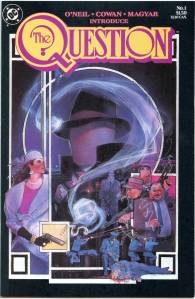
Created by writer-artist Steve Ditko, the Question first appeared in Charlton Comics‘ Blue Beetle #1 (June 1967). The character was acquired by DC Comics in the early 1980s and incorporated into the DC Universe.
The Question’s secret identity was originally Vic Sage. However, after the events of the 2006–2007 miniseries 52, Sage’s protégé Renee Montoya took up his mantle and became his successor. Following the DC relaunch The New 52, Sage is reintroduced as a government agent.
As conceived by Ditko, the Question was an adherent of objectivism during his career as a minor Charlton hero, much like Ditko’s earlier creation, Mr. A. In a 1987–1990 solo series from DC, the character developed a Zen-like philosophy.
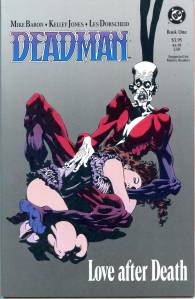
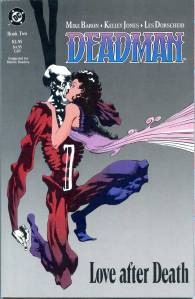
Death is the loneliest state of existence, a fact that Boston Brand never stopped to consider…at least not until he died. But after an assassin’s bullet cuts down the famed circus aerialist, Deadman learns the hard way what it’s like to be truly alone and all he can do is pray that he would one day find love after death. Investigating an abandoned circus in the Wisconsin Northwoods, Deadman comes upon another ghost…the spirit of a female aerialist who was rumored to have been murdered by her husband, the owner of the circus. The two spirits fall in love…but even death can’t protect her from her still-living husband’s jealousy as he unleashes a horde of side show horrors to keep them apart. But that’s only the tip of the supernatural iceberg and something even more sinister is under way.
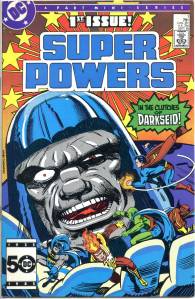
A second Super Powers, six-issue mini-series is published in 1985 and is set after the Hunger Dogs graphic novel. The second mini-series was written by Paul Kupperberg and illustrated by Jack Kirby (inked by Greg Theakston). Like its predecessor, this mini-series takes special attention to spotlight the new characters (and a few vehicles) being released in the wave 2 of the toy line. This second wave of the toy line was notable for including re-designed versions of Kirby’s Fourth World characters (Darkseid, Desaad, Mantis, Parademon, Kalibak, Steppenwolf) and Kirby manages to stay faithful to their toy line appearance throughout the mini-series.
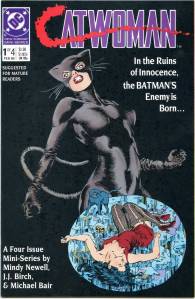
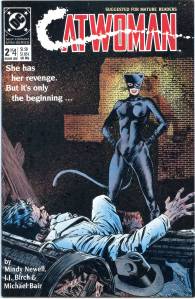
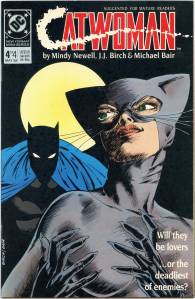
The 1989 Catwoman limited series, written by Mindy Newell and with art by J.J. Birch, expanded upon Miller’s Year One origin. This storyline, known as “Her Sister’s Keeper”, explores Selina’s early life as a dominatrix and the start of her career as Catwoman. The story culminates with Selina’s former pimp, Stan, abducting and beating her sister Maggie, who, in contrast to Selina, is a nun. Selina kills Stan to save her sister, and gets away with it. Most of this is revealed in the former series, but is expanded upon in “Her Sister’s Keeper”.
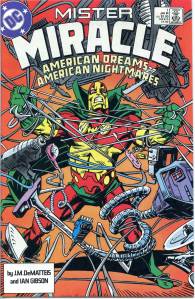
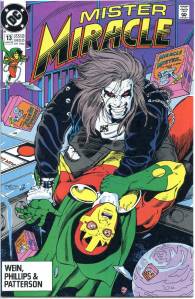
Mister Miracle was revived as part of the Justice League International lineup in 1987, a one-shot special by writer Mark Evanier and artist Steve Rude was published in 1987. This special was followed by an ongoing series that began in January 1989, written by J. M. DeMatteis and drawn by Ian Gibson. Other writers who contributed to the title include Keith Giffen, Len Wein, and Doug Moench. This run lasted 28 issues before cancellation in 1991. The series was largely humor-driven, per Giffen’s reimagining Scott Free, his wife Big Barda, and their friend Oberon, who pretended to be Scott’s uncle, as living in suburbia when they were not fighting evil with the Justice League.
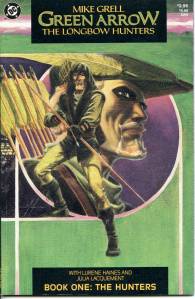
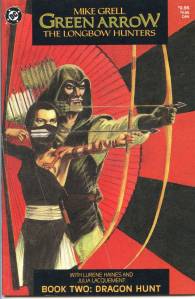
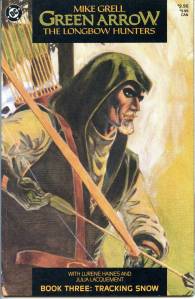
Green Arrow: The Longbow Hunters was nominated for a 1988 Eisner Award for Best Finite Series.
The series proved popular enough that DC Comics commissioned the first ever Green Arrow ongoing series, also written by Grell (writer from issues #1-80, 1988-1993).The series ran for 11 years. Grell would write a retelling of Green Arrow’s origin and first case in Secret Origins, (vol. 2) #38 (March 1989). Grell also wrote and illustrated the official Post-Crisis origin of Green Arrow in Green Arrow: The Wonder Year miniseries in 1993.
The series was major influence on TV series Arrow. Oliver is not referred to as “Green Arrow” in the show, wears a hooded costume similar to that worn in The Longbow Hunters, and in the first season, is willing to use lethal force. Edward Fyers is a main antagonist in the first season, and Shado has a recurring role in the first and second seasons. A character based on the Seattle Slasher, referred to as the Starling Slasher to match the show’s setting, appeared in the episode “Blind Spot.”
In 2014, writer Jeff Lemire used the name “Longbow Hunters” for a team of villains in his final story arc in the New 52 Green Arrow series.







 EHT Comics