Using the end of the New 52 initiative as a launching point, DC Comics began a second relaunch of its entire line of titles called DC Rebirth in 2016. Suicide Squad (vol. 5) #1 (August 2016) was the debut bimonthly relaunch of the team’s comic book title which consisted of Amanda Waller, Deadshot, Rick Flag, Captain Boomerang, Harley Quinn, Killer Croc, Katana & Enchantress. The Suicide Squad was given a new look, reflecting the team’s appearance in the DC Extended Universe.
Category: DC
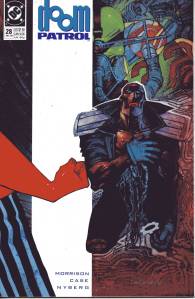
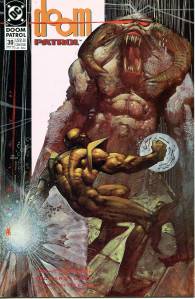
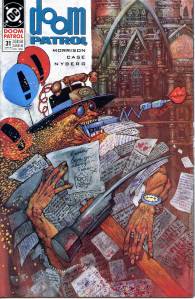
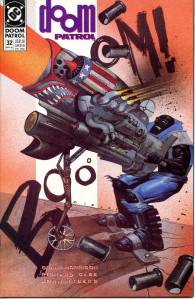
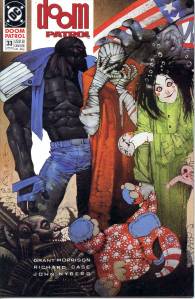
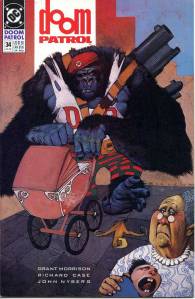
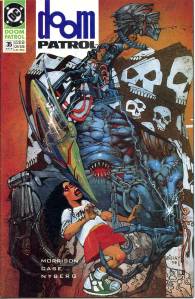
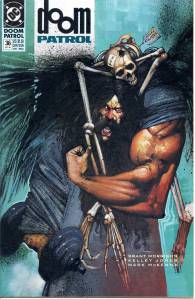
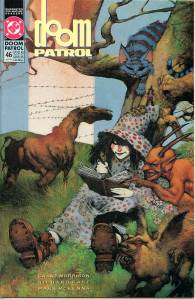
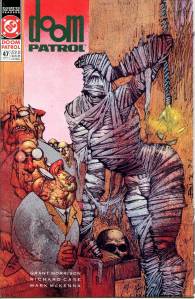
Doom Patrol V2 (1987)
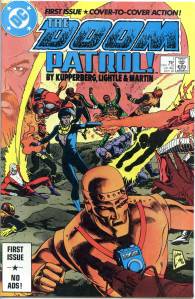
Paul Kupperberg laid the groundwork for the new series by writing the John Byrne illustrated Secret Origins Annual #1, published in 1987, which recapped the origins of the two iterations of the Doom Patrol that had existed thus far. In October 1987, DC relaunched Doom Patrol, written by Kupperberg and illustrated by Steve Lightle.
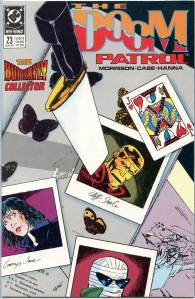
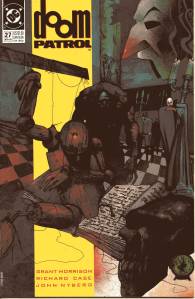
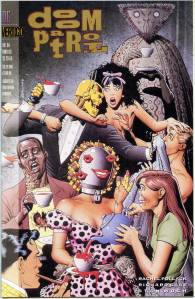
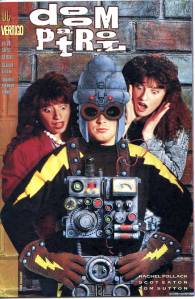
After the first 18 issues (and various crossovers and annuals), Kupperberg was replaced by Grant Morrison, starting with issue #19. Kupperberg agreed to help Morrison by writing out characters Morrison did not want to use: Celsius and Scott Fischer died before issue #18—Celsius was killed in an explosion in DC Comics’ “Invasion!” event, and Scott Fischer (already suffering from a recurrence of childhood leukemia) was the only known active superhero casualty of the Dominators‘ gene-bomb (also in “Invasion!”); Karma had left the team as he was still on the run from the law (he became a member of the Suicide Squad and died on his first mission with them in the “War of the Gods” crossover event); the Negative Spirit left Negative Woman’s body; and Lodestone plunged into a coma, where she would remain for the first half of Morrison’s run on the book. Tempest gave up fieldwork to become the team’s physician. Conversely, Morrison picked up a throw-away character from DP #14, who was slipped into the art on the last page of #18 to set up Morrison’s use: Dorothy Spinner is an ape-faced girl with powerful “imaginary friends.” Morrison also substantially retooled Negative Man: Larry Trainor (revealed to be alive in the Kupperburg run, as a prisoner of an underground society but now powerless) is forcibly merged with the Negative Spirit (now a cosmic entity) and a black doctor named Dr. Eleanor Poole, to create a transgender transracial gestalt entity known as Rebis. The new writer introduced some new characters to the team, including the multiple personality-afflicted Crazy Jane; and sentient roadway Danny the Street.
Blackest Night – Batman (2009)
Who Burns Who is a Blackest Night tie-in featuring the Batman Family, written by Peter Tomasi and illustrated by Ardian Syaf. It’s published in the three-issue Blackest Night: Batman mini-series. The story deals with resurrected agents of the Black Lantern Corps attacking Gotham through personal ties with its heroes, wielding dangerous power rings that reanimate them and feed off life energy through human hearts. There is a companion piece written as part of the Morrison’s Batman saga titled Blackest Knight, dealing with the resurrection of Bruce Wayne.
Super Sons (2017)
In 2016, DC Comics announced a new version of the Super Sons to appear in 2017. The two new super-kids are Damian Wayne, son of Bruce Wayne and Talia al Ghul, and Jonathan Kent, son of Superman and Lois Lane. The former is thirteen years of age in this version (as of the 80-page DC Universe Rebirth special), while the latter is ten years old. The advance releases describe them as “best frenemies forever” who will save the world together, “if they don’t kill each other first.” The series was launched in February 2017 and ended in May 2018 with 16 issues and 1 Annual.
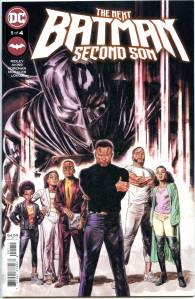
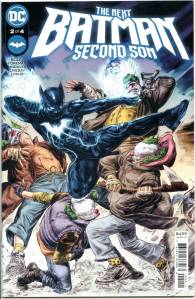
The Next Batman: Second Son (2021)
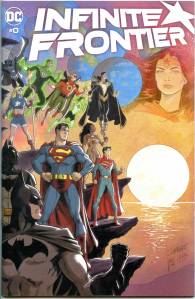
Readers now know that after the events of Future State, Tim Fox is the next Batman…but what’s his origin story? Why has he been estranged from Lucius Fox and his family for so long? Connected to the dramatic events of March’s Infinite Frontier #1, these questions and many more will be explored in this digital first miniseries!
Batgirl V1 (2000)
The first Batgirl monthly comic was published in 2000, with Cassandra Cain as the title character. Raised by assassin David Cain, Cassandra Cain was not taught spoken language, but instead was taught to “read” physical movement. Subsequently, Cain’s only form of communication was body language. The parts of the character’s brain normally used for speech were trained so Cain could read other people’s body language and predict, with uncanny accuracy, their next move. This also caused her brain to develop learning functions different from most, a form of dyslexia that hampers her abilities to read and write.
Despite Cain’s disability, author Andersen Gabrych describes the character’s unique form of language as the key factor in what makes Cain an excellent detective; the ability to walk into a room and “know” something is wrong based on body language. During the first arc of the Batgirl comic book series entitled “Silent Running”, Cassandra Cain encounters a psychic who “reprograms” her brain, enabling her to comprehend verbal language, while simultaneously losing the ability to predict movements. This issue is resolved during the second arc of the series, “A Knight Alone”, when Batgirl encounters the assassin Lady Shiva who agrees to teach her how to predict movement once again. Six years after its debut, DC Comics cancelled the Batgirl comic book series with issue #73 (2006), ending with Cain relinquishing her role as Batgirl.

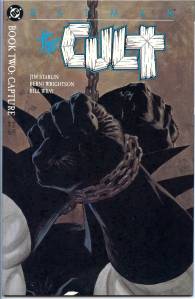
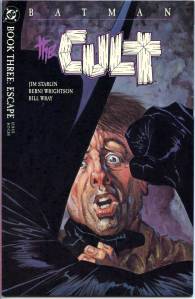
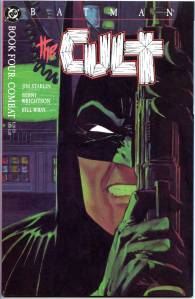
Batman: The Cult (1988)
Batman: The Cult is a four-issue mini-series. It was published by DC Comics in their prestige format books and released in 1988. It was written by Jim Starlin, illustrated by Bernie Wrightson, colored by Bill Wray and edited by Denny O’Neil.
The story follows the machinations of Deacon Blackfire and his band of homeless followers who have kidnapped Batman before the events of this story. Following a lengthy period of captivity Batman slowly succumbs to brainwashing. Batman is eventually freed from the cult but takes a long time to recover from his treatment at their hands. The story also delves into other territory. Gotham City politicians are assassinated by Blackfire’s party of followers. An attempt on Commissioner Gordon‘s life is tried by Blackfire’s group, leaving the commissioner in a hospital. Beyond Gotham authorities to protect the city, the national guard is called in, then the military and martial law is declared on Gotham. The series also features the second Robin, Jason Todd.
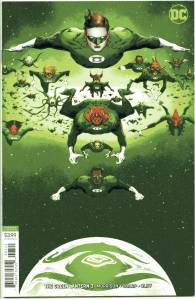
THE Green Lantern V1 (2019)
The Green Lantern (Volume 1) is an ongoing series, published by DC Comics. It began publication in 2019. It stars Green Lantern. It replaced both Green Lanterns (Volume 1) and Hal Jordan and the Green Lantern Corps (Volume 1) in DC’s publication schedule.
While Hal Jordan is the central character, the series’ title doesn’t necessarily refer to him but to the Green Lantern Corps central power battery. Writer Grant Morrison explains that the title is influenced by the 1950s British police procedurial television series The Blue Lamp.
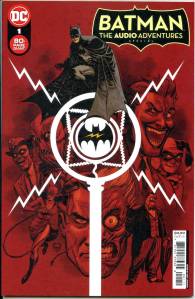
Batman – The Audio Adventures (2021)
The Stories Behind The Stories Behind The Hit HBO Max Scripted Original Podcast With This Sensational Prequel One-Shot, Written By The Very Creators And Talent Who Lent Their Voices To The Show. And Unless You’ve Been Living In A Cave, You Know That After Years Of Rumors We Find Out Not Only Is The Batman Real, Not Only Is He One Of The Good Guys, Turns Out, He’s Gonna Be A Cop!

The Shadow V3 (1987)
The Shadow, set in our modern era, was continued in 1987 as a monthly DC comics series by writer Andy Helfer (editor of the miniseries); it was drawn primarily by artists Bill Sienkiewicz (issues 1–6) and Kyle Baker (issues 8–19 and two Shadow Annuals).