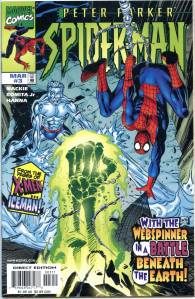
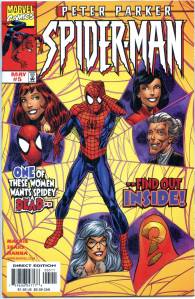
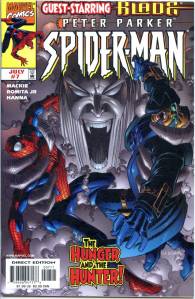
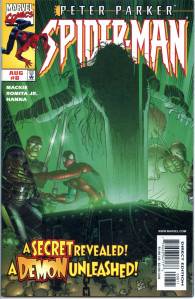
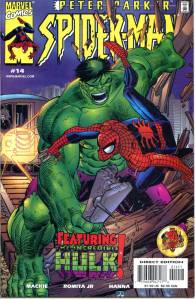
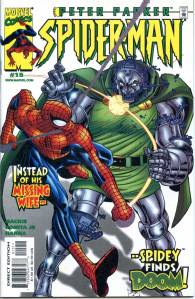
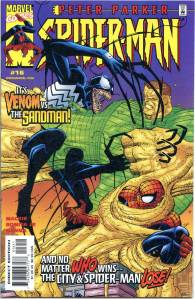
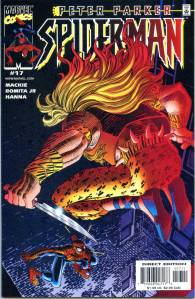
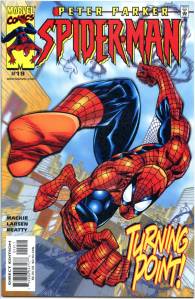
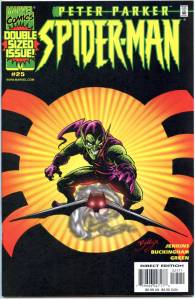
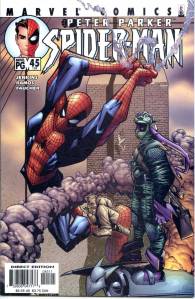
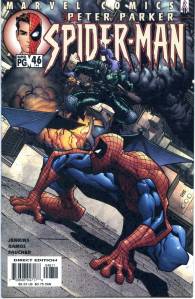
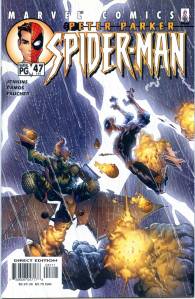
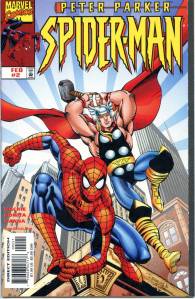
Peter Parker: Spider-Man V2 (1999)

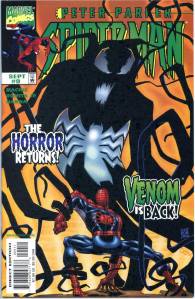
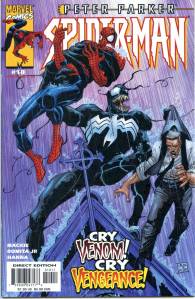
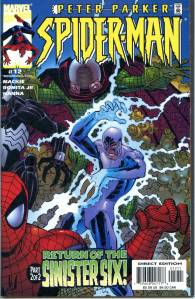
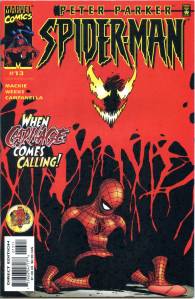
This series was a continuance of (vol. 1), with the creative team of Howard Mackie and John Romita Jr. having migrated to the new series. In June 2001, Marvel began a dual numbering system on all its titles that had been relaunched and renumbered. The first issue of Peter Parker: Spider-Man to be dual-numbered was listed as both #30 and #128 on the cover – the second figure achieved by adding the total of issues of the new volume (30) to the first volume’s 98. The comic’s legal indicia, printed on the title page, still listed the series as (vol. 2) #30.

Mackie and Romita Jr. remained through issue #20 (August 2000) when writer Paul Jenkins and artist Mark Buckingham became the new creative team. Jenkins would write the character over different titles for the next five years. Buckingham and Jenkins left Peter Parker: Spider-Man after issue #50 (Jan. 2003) and were briefly succeeded by writer Zeb Wells and an assortment of artists.
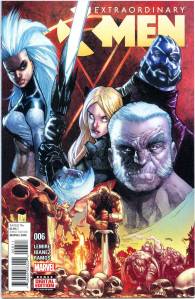
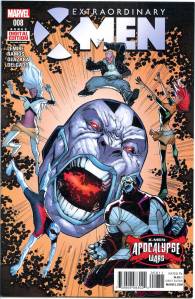
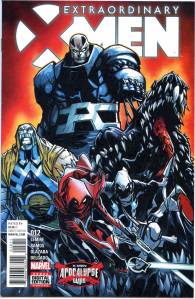
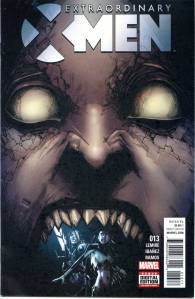
Extraordinary X-Men (2016)

The story takes place following the conclusion of the Secret Wars crossover event. In this comic series, mutants are again faced with possible extinction due to Terrigen Mist which causes exposed mutants to become sterile and possibly suffer from a fatal degenerative disease called “M-Pox”. The gas also prevents the activation of the X-Gene. The series ended with #20.

Bill & Ted’s Excellent Comic Book (1991)

The first two issues revolve around the efforts of Bill (Bill S. Preston, Esq.) and Ted (Theodore Logan) as they plan a party to celebrate their recent nuptials. Unfortunately the personification of mortality, Death, a more recent ally, becomes vastly out of sorts and steals the phone-booth time machine. Rufus, their old guide, helps by directing them to a prototype for the phone booth/time machine. Bill and Ted must take the device and find Death before he causes too much damage to the time stream. The two also must deal with jealous rivals, who do not accept that Bill and Ted’s wives had freely chosen to marry.

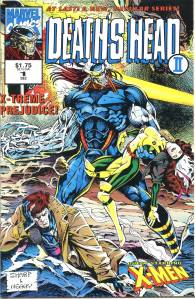
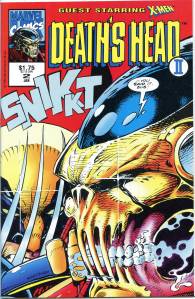
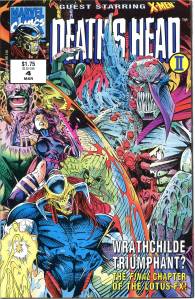
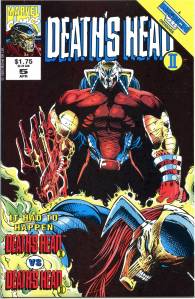
Death’s Head 2 V2 (1993)

Originally launched as a four-issue limited series, Death’s Head II then became an ongoing series – and also featured in a number of team-up limited series designed to showcase new Marvel UK characters. One of these was Death3, teaming up Death’s Head II with newly created “brothers”, Death Metal and his prototype Death Wreck. The recurring character throughout this was Dr Evelyn Necker, the scientist who creates the Minion series (Death’s Head II and his “brothers”). Death’s Head II became the flagship character for Marvel UK – a costume was even made for promotional appearances and was part of the 1993 Lord Mayor’s Show – and there were concerns at Marvel UK in early 1993 that they could be overestimating his popularity and over-exposing the character. When Marvel UK was cancelled, a Death’s Head II/Punisher crossover was in production and he was playing a key role in the completed, but never published, Loose Cannons (released online).

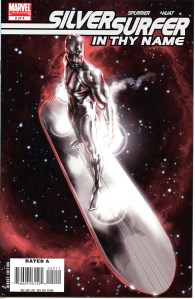
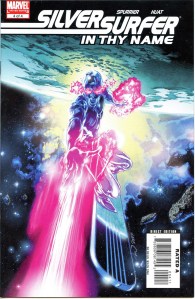
Silver Surfer – In Thy Name (2007)

The Silver Surfer delves alone into the furthest depths of the void; tangling with organ-stealing pirates, demonic beasts and a race of alien aristocrats. Everyone’s favorite Cosmic Wanderer discovers that even in the midst of a galactic utopia, horror is never far away…With electrifying artwork by the dynamic Tan Eng Huat (Doom Patrol, Batman) and an endlessly inventive script by Simon Spurrier.

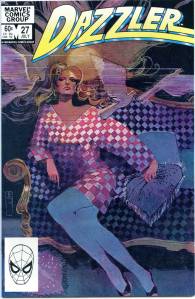
Dazzler (1981)

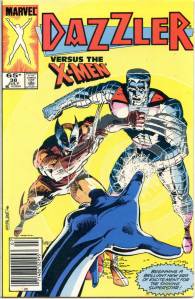
mutant with the ability to convert sound vibrations into light and energy beams, Dazzler was developed as a cross-promotional, multi-media creation between Casablanca Records and Marvel Comics until the tie-ins were dropped in 1980. The character was created by a committee of Marvel staff, principally writer/editor Tom DeFalco and illustrator John Romita Jr.

Despite the fact that Dazzler was commissioned as a disco singer, the character shifted to other musical genres, including rock and adult contemporary. She starred in a self-titled series in the early 1980s which lasted forty-two issues, a Marvel Graphic Novel titled Dazzler: The Movie, a four-issue limited series co-starring The Beast titled Beauty and the Beast, and later joined the cast of the X-Men. She was briefly a member of the spin-off group Excalibur but has since re-joined the X-Men.

Captain Marvel (2014)

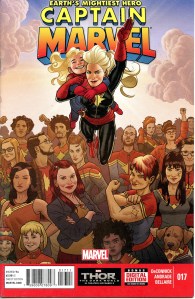
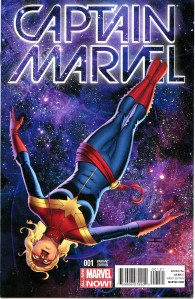
In July 2012, Carol Danvers, the longtime super-heroine known as Ms. Marvel, assumed the mantle of Captain Marvel in an ongoing series written by Kelly Sue DeConnick with art by Dexter Soy. Danvers dons a jumpsuit and explores her own past. DeConnick said at WonderCon 2012 that her pitch for the series could be described as “Carol Danvers as Chuck Yeager“. She said the series would contemplate what Captain Marvel’s legend means to Danvers, how she will wield it, and how the rest of the Marvel Universe reacts.

Carnage: It’s a Wonderful Life (1996)

Cletus Kasady was introduced in The Amazing Spider-Man #344 and first appears as Carnage in issue #361. He is the main villain in the 1993 “Maximum Carnage” crossover, a 14-part story line crossover that spanned through all the Spider-Man titles. In 1996, two one-shot comics centered entirely around Carnage were released, entitled Carnage: Mind Bomb and Carnage: It’s A Wonderful Life, both of which expand on his character.

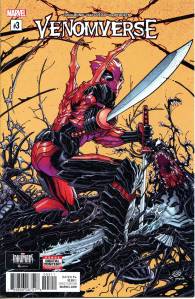
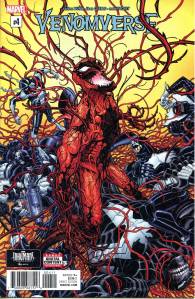
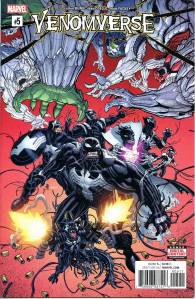
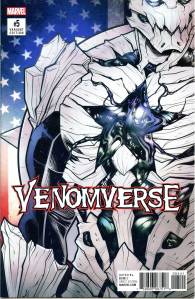
Venomverse (2017)

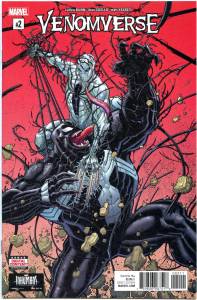
The actual Venomverse arc was released after the conclusion of the Edge of… miniseries, it was written by Cullen Bunn and drawn by Iban Coello, who had already worked toguether in Deadpool & the Mercs for Money. The editor Devin Lewis described it as “the biggest Venom story of all time”, and it intended to make Venom an important character in the Marvel universe. Bunn pointed that most of the other main characters were selected because they would seem unexpected hosts of the symbiote. Lewis mentioned Deadpool in particular, and said that “Deadpool is one of our main venomized protagonists. He’s got so much heart and he’s also a source of unpredictability, insanity, and goofiness”. Bunn preferred instead his version of Rocket Raccoon.

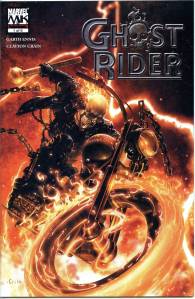
Ghost Rider V5 (2005)

Following the western comics character who originally used the name, the first superhero Ghost Rider, Johnny Blaze, debuted in Marvel Spotlight #5 (Aug. 1972), created by writer-editor Roy Thomas, writer Gary Friedrich, and artist Mike Ploog. He received his own series in 1973, with penciller Jim Mooney handling most of the first nine issues. Several different creative teams mixed-and-matched until penciller Don Perlin began a considerably long stint with issue #26, eventually joined by writer Michael Fleisher through issue #58. The series ran through in issue #81 (June 1983). Blaze returned as Ghost Rider in a 2001 six-issue miniseries written by Devin Grayson; a second miniseries written by Garth Ennis in 2005; and an ongoing monthly series that began publication in July 2006. Johnny Blaze was the son of Naomi Blaze and Barton Blaze, Naomi being the previous Ghost Rider.