Amazing Adventures was a split title featuring the Inhumans (initially both written and drawn by Jack Kirby, later drawn by Neal Adams) and the Black Widow (initially by writer Gary Friedrich and pencilerJohn Buscema). The Widow was dropped after vol. 2, #8, and full-length Inhumans stories ran for two issues before that feature, too, was dropped.
Vol. 2, #11 (March 1972) introduced solo stories of erstwhile X-Men member the Beast, in which he was mutated into his modern-day blue-furred (originally grey-furred) form. The initial story was by writer Gerry Conway, penciler Tom Sutton, and inkerSyd Shores. Steve Englehart became the feature’s writer with issue #12 and added Patsy Walker and her then-husband, “Buzz” Baxter, to the Beast’s supporting cast in issue #13.
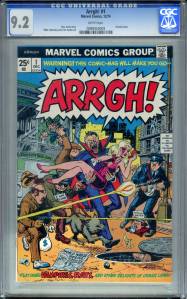
In late 1982 (cover dated January 1983), Marvel published a humorous one-shot comic featuring some of their most notorious goofs. Subtitled “Mighty Marvel’s Most Massive Mistakes”, the book was organized and spearheaded by Jim Owsley and had a cover which was deliberately printed upside-down. In the comic’s story Lee, with the help of artists Bob Camp and Vince Colletta, exposes and pokes fun at typos, misspellings and other errors.
Attacked by the forces of fellow Cabal member Doctor Doom, T’Challa is left comatose. His sister Shuri is trained as the next Panther, with the mantle passing onto her officially after T’Challa awakens from his coma and attempts to recover from his injuries.
In the aftermath, T’Challa loses all of his enhanced attributes given to him by being the panther totem. As a result, he works with his sorcerer, Zawavari, to accumulate a replacement. He has since made a pact with another unknown Panther deity, returning his attributes to an even higher level as well as placing incantations on his body, making himself highly resistant to most magic and mystic assaults. This has all been done in preparation for the imminent battle with Doctor Doom, which culminated in T’Challa rendering all of the processed vibranium inert to give his people a chance to rebuild without their dependence on the element.
Marvel began The Amazing Spider-Man anew with (vol. 2) #1 (Jan. 1999). Howard Mackie wrote the first 29 issues. The relaunch included the Sandman being regressed to his criminal ways and the “death” of Mary Jane, which was ultimately reversed. Other elements included the introduction of a new Spider-Woman (who was spun off into her own short-lived series) and references to John Byrne’s miniseries Spider-Man: Chapter One, which was launched at the same time as the reboot. Byrne also penciled issues #1–18 (from 1999 to 2000) and wrote #13–14, John Romita Jr. took his place soon after in October 2000. Mackie’s run ended with The Amazing Spider-Man Annual 2001, which saw the return of Mary Jane, who then left Parker upon reuniting with him.
With issue #30 (June 2001), J. Michael Straczynski took over as writer and oversaw additional storylines – most notably his lengthy “Spider-Totem” arc, which raised the issue of whether Spider-Man’s powers were magic-based, rather than as the result of a radioactive spider’s bite. Additionally, Straczynski resurrected the plot point of Aunt May discovering her nephew was Spider-Man, and returned Mary Jane, with the couple reuniting in The Amazing Spider-Man (vol. 2) #50. Straczynski gave Spider-Man a new profession, having Parker teach at his former high school.
Issue #30 began a dual numbering system, with the original series numbering (#471) returned and placed alongside the volume two number on the cover. Other longtime, rebooted Marvel Comics titles, including Fantastic Four, likewise were given the dual numbering around this time. After (vol. 2) #58 (Nov. 2003), the title reverted completely to its original numbering for issue #500 (Dec. 2003). Mike Deodato, Jr. penciled the series from mid-2004 until 2006.
The first Captain Marvel was created by Stan Lee and Gene Colan in Marvel Super-Heroes #12 (December 1967). This character is an alien military officer, Captain Mar-Vell of the Kree Imperial Militia, who is sent to observe the planet Earth as it is developing technology to travel into space. Mar-Vell eventually wearies of his superiors’ malign intent and allies himself with Earth, and the Kree Empire brands him a traitor. From then on, Mar-Vell fights to protect Earth from all threats.
He was later revamped by Roy Thomas and Gil Kane. Having been exiled to the Negative Zone by the Supreme Intelligence, the only way Mar-Vell can temporarily escape is to exchange atoms with Rick Jones by means of special wristbands called Nega-Bands. He is also given superpowers and his Kree military uniform is replaced with a form fitting costume.
With the title’s sales still flagging, Marvel allowed Jim Starlin to conceptually revamp the character, although his appearance was little changed. Mar-Vell is freed from the Negative Zone and becomes a cosmic champion, the “Protector of the Universe” appointed by the cosmic entity Eon. Together, Mar-Vell and Rick continue to battle against evil, most notably battling the Death-worshipping Thanos. Mar-Vell became a close ally of the Titans, and one of their number, Elysius, became his lover.
The Moebius pseudonym, which Jean Giraud came to use for his science fiction and fantasy work, was born in 1963. In a satire magazine called Hara-Kiri, Giraud used the name for 21 strips in 1963–64. Subsequently, the pseudonym went unused for a decade.
Arzach is a wordless comic, created in a conscious attempt to breathe new life into the comic genre which at the time was dominated by American superhero comics. It tracks the journey of the title character flying on the back of his pterodactyl through a fantastic world mixing medieval fantasy with futurism. Unlike most science fiction comics it has no captions, no speech balloons and no written sound effects. It has been argued that the wordlessness provides the strip with a sense of timelessness, setting up Arzach’s journey as a quest for eternal, universal truths.
His series The Airtight Garage is particularly notable for its non-linear plot, where movement and temporality can be traced in multiple directions depending on the readers own interpretation even within a single planche (page or picture). The series tells of Major Grubert, who is constructing his own universe on an Asteroid named fleur, where he encounters a wealth of fantastic characters including Michael Moorcock‘s creation Jerry Cornelius.
In 1980 he started his famous L’Incal series in collaboration with Alejandro Jodorowsky. From 1985 to 2001 he also created his six-volume fantasy series Le Monde d’Edena, portions of which appeared in English as The Aedena Cycle.
In his later life, Giraud decided to revive the Arzak character in an elaborate new adventure series; the first volume of a planned trilogy, Arzak l’arpenteur, appeared in 2010. He also added to the Airtight Garage series with a new volume entitled Le chasseur déprime.
The end of the spider-verse is coming! edge (‘ej) noun – 1. outermost limit of an object – 2. the sharp side of a blade. The leading edge of the Spider-Verse brought you Spider-Gwen and Peni Parker. This final edge will introduce you to some of the most important characters in the future of the Spider-Verse…but it will also slice the final strand of the web.
Comics journalist Jonathan Miller summarized Marvel Team-Up in a retrospective article:
“The series was admittedly formulaic; either Spider-Man or that issue’s guest-star would encounter a menace and then by sheer chance cross paths with another hero who would lend a hand. The title’s guest-stars were an equal mix of A-list characters whose presence was likely to increase sales and fledgling heroes being given exposure in the hopes of launching them into stardom but who for the most part continued to languish in obscurity.”
The third Marvel Team-Up series launched in January 2005 and ran for 25 issues which starred a variety of characters.
The series was written by Dan Slott with artwork by Ryan Stegman, Humberto Ramos, and Giuseppe Camuncoli. The storyline sees a dying Otto Octavius swapping bodies with Peter Parker and allowing Parker to die in his body. However, he later learns about responsibility and redeems himself. Adopting the alias “Superior Spider-Man”, he becomes a superhero and is determined to prove himself as a better Spider-Man than Parker ever was, and a better man than Octavius.
Soon after the publication of The Incredible Hulk #449, the team’s own series premiered. The first issue, cover dated April 1997, was played largely as a straight superhero story, until the revelation of the Thunderbolts’ true nature on the last page of the comic. This is considered one of the most well-conceived plot twists in the history of American comic books, with Wizard magazine readers voting it “Comics’ Greatest Moment of 1997” and later, in 1999, placing it at #11 on a list of “The 25 Greatest Comic Moments Ever”. Marvel managed to keep the secret of the Thunderbolts’ true villainous identities tightly under wraps before the book launched. When word got out, the first issue sold out so quickly that Marvel not only offered a second printing, but also did a “mini-trade paperback” collecting the first two issues. Fabian Nicieza replaced Busiek in issue #34. Patrick Zircher, after a couple of fill-ins, replaced Bagley in issue #51.