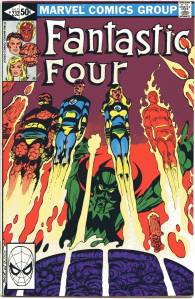
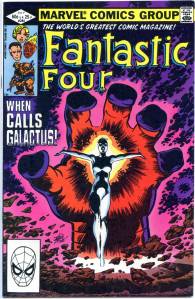
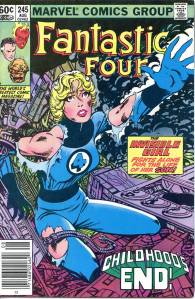
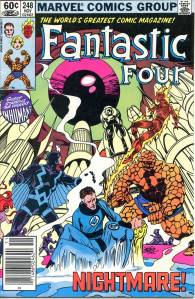
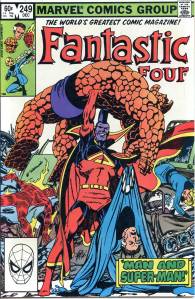
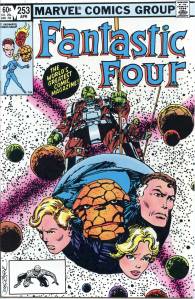
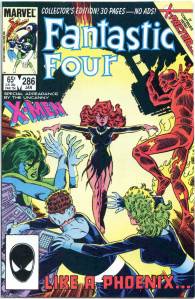
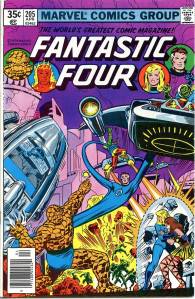
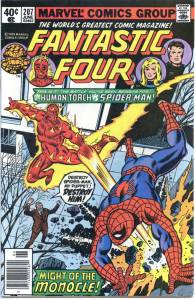
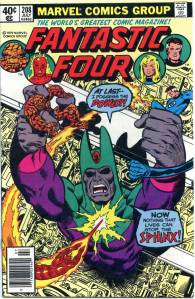
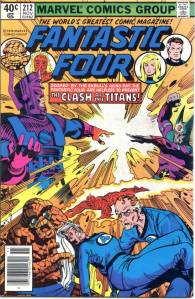
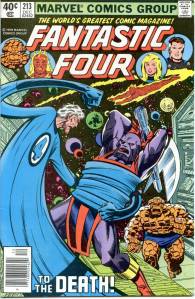
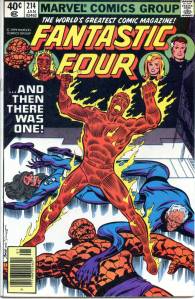
John Byrne revitalized the slumping title with his run. Originally, Byrne was slated to write with Sienkiewicz providing the art. Sienkiewicz left to do Moon Knight, and Byrne subsequently became writer, artist, and inker. Various editors were assigned to the comic; eventually Bob Budiansky became the regular editor. Byrne told Jim Shooter that he could not work with Budiansky, although they ultimately continued to work together. In 2006, Byrne said “that’s my paranoia. I look back and I think that was Shooter trying to force me off the book”. Byrne left following issue #293 (Aug. 1986) in the middle of a story arc, explaining he could not recapture the fun he had previously had on the series. One of Byrne’s changes was making the Invisible Girl into the Invisible Woman: assertive and confident. During this period, fans came to recognize that she was quite powerful, whereas previously, she had been primarily seen as a superpowered mother and wife in the tradition of television moms like those played by Donna Reed and Florence Henderson.
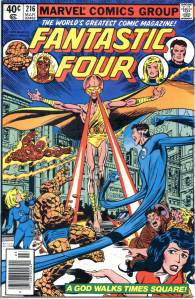
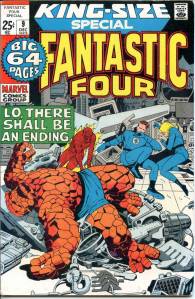
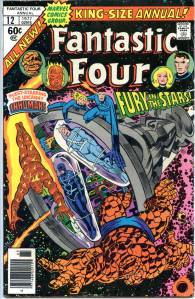
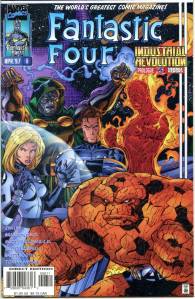
Fantastic Four #218 VF-NM $5Fantastic Four #220 VF $3Fantastic Four #232 VF-NM $9Fantastic Four #235 CGC 9.8 White Pages $89Fantastic Four #239 VF+ $3Fantastic Four #242 VF+ $3Fantastic Four #244 VF $29Fantastic Four #245 VF+$9Fantastic Four #248 Newstand VF+$4Fantastic Four #248 VF-NM $4Fantastic Four #249 Newstand VF+ $3Fantastic Four #249 VF-NM $3Fantastic Four #250 NM $6Fantastic Four #251 Newstand VF-NM $5Fantastic Four #251 VF-NM $4Fantastic Four #253 Newstand VF+ $4Fantastic Four #253 VF-NM $4Fantastic Four #254 Newstand VF+ $4Fantastic Four #254 VF-NM $4Fantastic Four #256 VF+ $3Fantastic Four #277 NM- $8Fantastic Four #286 Newsstand NM- $12Fantastic Four #286 NM $12Fantastic Four #292 Newsstand VF+ $9Fantastic Four #293 Newsstand VF+ $6Fantastic Four #299 VF+ $5Fantastic Four #303 VF-NM $2Fantastic Four #314 NM- $4Fantastic Four #316 VF-NM $3Fantastic Four #323 NM- $4Fantastic Four #324 VF-NM $3Fantastic Four #326 VF-NM $2
Stan Lee said he created a synopsis for the first Fantastic Four story that he gave to penciller Jack Kirby, who then drew the entire story. Kirby turned in his penciled art pages to Lee, who added dialogue and captions. This approach to creating comics, which became known as the “Marvel Method“, worked so well for Lee and Kirby that they used it from then on; the Marvel Method became standard for the company within a year.
Kirby recalled events somewhat differently. Challenged with Lee’s version of events in a 1990 interview, Kirby responded: “I would say that’s an outright lie”, although the interviewer, Gary Groth notes that this statement needs to be viewed with caution.Kirby claims he came up with the idea for the Fantastic Four in Marvel’s offices, and that Lee had merely added the dialogue after the story had been pencilled. Kirby has also sought to establish, more credibly and on numerous occasions, that the visual elements of the strip were his conceptions. He regularly pointed to a team he had created for rival publisher DC Comics in the 1950s, Challengers of the Unknown. “[I]f you notice the uniforms, they’re the same… I always give them a skintight uniform with a belt… the Challengers and the FF have a minimum of decoration. And of course, the Thing’s skin is a kind of decoration, breaking up the monotony of the blue uniform.” The characters wear no uniforms in the first two issues.
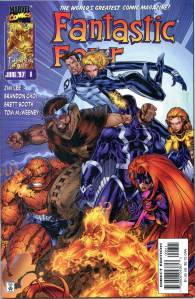
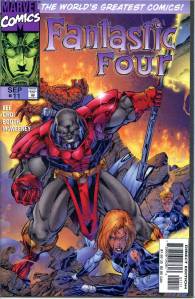
The ongoing series was canceled with issue #416 (Sept. 1996) and relaunched with vol. 2 #1 (Nov. 1996) as part of the multi-series “Heroes Reborn” crossover story arc. The yearlong volume retold the team’s first adventures in a more contemporary style, and set in a parallel universe. Following the end of that experiment, Fantastic Four was relaunched with vol. 3 #1 (Jan. 1998).
A new volume for the Fantastic Four was released in August 2018, written by Dan Slott, as part of Marvel’s Fresh Start event. The first issue of the new series was met with strong sales, and a positive critical reaction. When the Future Foundation is threatened by the Griever at the End of All Things, Mister Fantastic plays on her ego to convince her to provide him with equipment that will allow him to summon his teammates. When Human Torch and Thing are reunited with Mister Fantastic and Invisible Woman, the other superheroes that were part of the Fantastic Four at some point in their lives also arrived, including unexpectedly, X-Men‘s Iceman. With the gathered heroes assisted the Fantastic Four into causing so much damage to the Griever’s equipment, she is forced to retreat in her final telepod or be trapped in that universe. This left the heroes to salvage components from the broken ship to create their own teleport system to return to their universe.
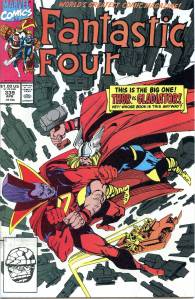
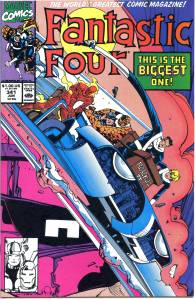
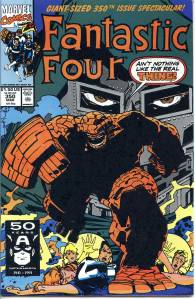
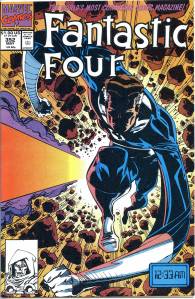
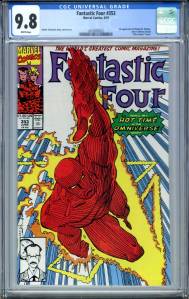
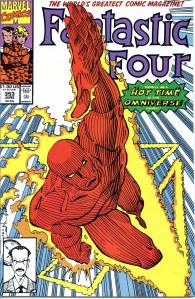
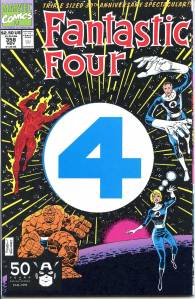
Writer-artist Walt Simonson took over as writer of Fantastic Four with #334 (December 1989), and three issues later began pencilling and inking as well. With brief inking exceptions, two fill-in issues, and a three-issue stint drawn by Arthur Adams, Simonson remained in all three positions through #354 (July 1991).
Simonson, who had been writing the team comic The Avengers, had gotten approval for Reed and Sue to join that team after Engelhart had written them out of Fantastic Four. Yet by The Avengers #300, where they were scheduled to join the team, Simonson was told the characters were returning to Fantastic Four. This led to Simonson quitting The Avengers after that issue. Shortly afterward, he was offered the job of writing Fantastic Four. Having already prepared a number of stories involving the Avengers with Reed and Sue in the lineup, he then rewrote these for Fantastic Four. Simonson later recalled that working on Fantastic Four allowed him the latitude to use original Avengers members Thor and Iron Man, which he had been precluded from using in The Avengers.
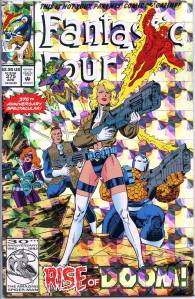
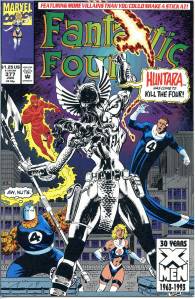
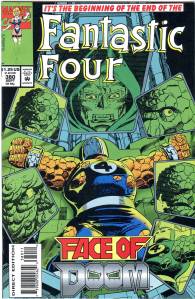
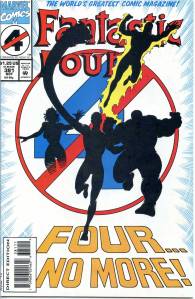
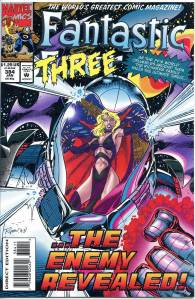
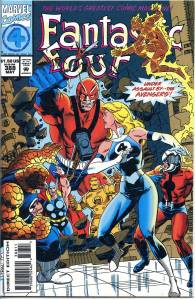
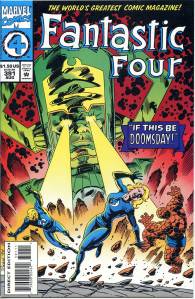
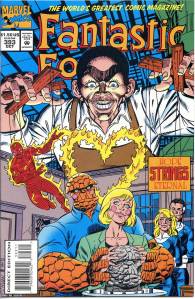
After another fill-in, the regular team of writer and Marvel editor-in-chief Tom DeFalco, penciller Paul Ryan and inker Dan Bulanadi took over, with Ryan self-inking beginning with #360 (Jan. 1992). That team, with the very occasional different inker, continued for years through #414 (July 1996). DeFalco nullified the Storm-Masters marriage by retconning that the alien Skrull Empire had kidnapped the real Masters and replaced her with a spy named Lyja. Once discovered, Lyja, who herself had fallen for Storm, helped the Fantastic Four rescue Masters. Ventura departed after being further mutated by Doctor Doom. Although some fans were not pleased with DeFalco’s run on Fantastic Four, calling him “The Great Satan”, the title’s sales increased over the period.
Beginning with issue #554 (April 2008), writer Mark Millar and penciller Bryan Hitch began what Marvel announced as a sixteen-issue run. Following the summer 2008 crossover storyline, “Secret Invasion“, and the 2009 aftermath “Dark Reign“, chronicling the U.S. government’s assigning of the Nation’s security functions to the seemingly reformed supervillain Norman Osborn, the Fantastic Four starred in a five-issue miniseries, Dark Reign: Fantastic Four (May–Sept. 2009), written by Jonathan Hickman, with art by Sean Chen. Hickman took over as the series regular writer as of issue #570 with Dale Eaglesham and later Steve Epting on art.























































 EHT Comics