It’s been a while since Deadpool’s had to merc to make ends meet, but things are tough all over. While Deadpool tries to get his humble mercenary-for-hire business back off the ground, a catastrophic threat so unfathomably huge, so mind-breakingly cataclysmic it defies description, is heading toward Earth, and there’s only ONE PERSON WHO CAN STOP IT!!!
When a young X-Man breaks the laws of Krakoa and takes a life, it’s up to Wolverine to track down his former student and take her down… But Nature Girl is tired of standing by while humanity destroys her home. Can even Logan quell her fury? Find out as a good girl breaks bad to save the planet!
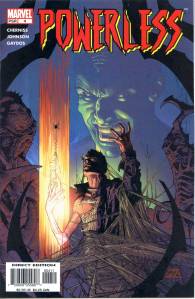
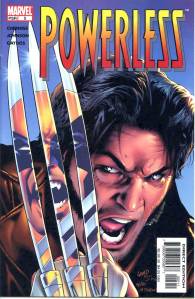
A psychologist named William Watts wakes up in a hospital after a three day coma. Fresh in his mind is the world of Earth-616 which he experienced while asleep. As William returns to his mundane daily life, he encounters three familiar faces: Peter Parker, a high-school student who is pressured by Norman Osborn to conduct industrial espionage on Stark Industires; a blind lawyer Matt Murdock who battles an uphill case against the kingpin to absolve Frank Castle of murder; and an amnesiac soldier named Logan who is led to believe he murdered Charles Xavier. Inspired by Matt’s conviction, William leaves his bystander position and begins to act to help the three: he helps reveal Charles’ murder was done by a third party, citing Logan to investigate Eric Magnus; he convinces Frank Castle to reveal vital information to Matt’s case; and he acts by calling the cops to assist Peter in arresting Osborn. After Frank’s trial, the Kingpin murders Murdock. Castle assassinates Kingpin in retaliation, which places him on the road to becoming the real-life Punisher. The series ends with William contemplating how the coma has shaken him from the stupor of life, as he reflects on his coma identity as Uatu.
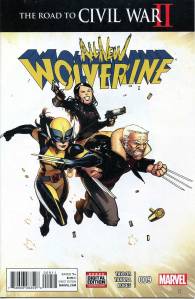
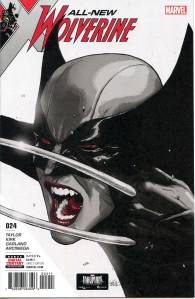
The character X-23 becomes the new Wolverine in the series, succeeding Logan, with a new costume resembling the original Wolverine’s. The series is written by Tom Taylor with art by David López.
In this second volume, MacKay and artist C.F. Villa took the Black Cat’s larcenous adventures into the realm of cosmic horror with an inaugural arc that tied into the King in Black event. After that arc came to a close in Black Cat #3, Black Cat #4 MacKay and artist Nina Vakueva reintroduce their protagonist’s ongoing war with New York City’s shadowy Thieves Guild and set up an arc that pays off on that long-form story that’s been building since 2019’s Black Cat #1.
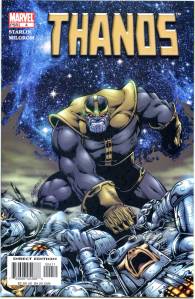
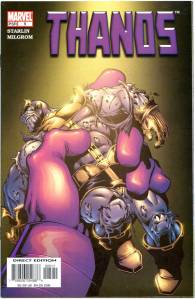
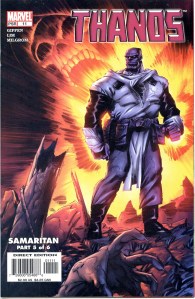
In 2004 Thanos received an eponymous title that ran for 12 issues. After defeating the Hunger, Thanos went to the frontline and gave himself up to the Omega Corps. After a panicked action from the corps they send him to the Kyln. On his way he killed a Skrull agent to give them a reason to imprisoned him. On Kyln, a priest told him about the prison while Thanos is watching the Crunch. When the Priest left, Death appeared and talked to him, telling him She loves him in her way, and that he hadn’t given her anything that she didn’t already have.
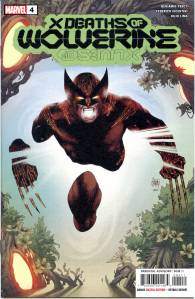
If Wolverine’s future lies in the past, what does that mean for the present? The reciprocal series to X Lives of Wolverine, X Deaths of Wolverine is chock-full of revelations for the best there is as well as the fate of mutantkind.
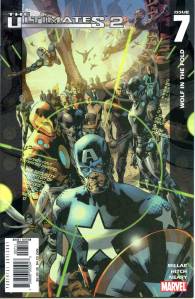
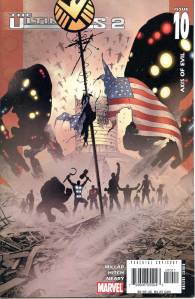
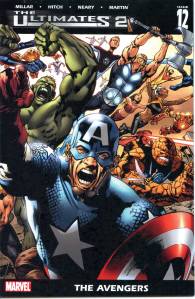
In a 2004 interview, Millar outlined the difference between the Ultimates and the Avengers: “The idea behind The Avengers is that the Marvel Universe’s biggest players all get together and fight all the biggest supervillains they can’t defeat individually, whereas Ultimates 2 is an exploration of what happens when a bunch of ordinary people are turned into super-soldiers and being groomed to fight the real-life war on terror.”
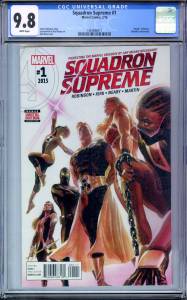
This team, set in Marvel’s mainstream reality, features characters from numerous alternate universes, such as the Nighthawk from Supreme Power, a Hyperion from a reality that had been destroyed upon colliding with another universe, Doctor Spectrum from the world of the Great Society (which was destroyed by Namor the Sub-Mariner to prevent it from colliding with the mainstream universe), the Blur from the New Universe, and Warrior Woman from a Secret Wars tie-in (posing as the Earth-712 Squadron Supreme’s Power Princess).
















 EHT Comics