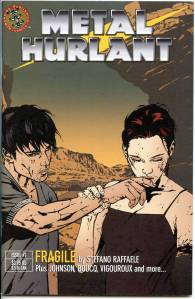
Métal Hurlant began publishing again in July 2002 by Humanoids Publishing, with a French, English, Spanish and Portuguese version, under the French name. As a “two-headed”, transatlantic (France-US) magazine, led by Fabrice Giger in Los Angeles, it published original short stories, sometimes related to existing or to be published comic books. Its aim was to discover young creators and promote the products from the publisher. This incarnation of the magazine ceased publication with issue No. 14, dated November/December 2004.
Category: Independent Iron Age
Poison Elves – Mulehide Graphics (1990’s)
I, Lusiphur (December 1991-December 1992) – Poison Elves (February 1993-February 1995) Hayes originally self-published the series during the early 90s under his company Mulehide Graphics under the title of I, Lusiphur. The title was changed to Poison Elves because the similarity of Lusiphur to Lucifer led to the misconception that the series was Satanic in nature. Sales were reported to have increased significantly after the name change. Drew claimed in one of his Starting Notes that the name change was prompted by a letter from a teen-aged fan whose mother had thrown out his comics after finding I, Lusiphur comics amongst his collection.
The first ten issues of the Mulehide series were published in a larger magazine size format. In 1995, Drew Hayes signed on with Sirius Entertainment, a move that increased his exposure, fan base, and publishing rate. To date, ten trade paperbacks have been released, but the last issue of the main series published by Sirius was #79. Hayes died in 2007, thus bringing the series to an abrupt end. A commemorative issue #80 was released to give fans a look at sketches and plans Drew Hayes had for the future of the series before his death.
I Before E (1991)
A year or so before Image began publishing Sam Kieth’s most famous work, Maxx, Fantagraphics produced two volumes of Kieth’s drawings and short stories as I Before E. With creepy aliens, prowling tigers, and visual treats like the short story “Max the Hare,” these two comic-sized volumes make a fine companion to any Sam Kieth collection.
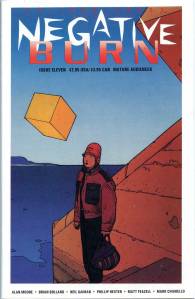
Negative Burn V1 (1993)
Negative Burn is a black-and-white anthology comic book published beginning in 1993 by Caliber Press, and subsequently by Image Comics and Desperado Publishing. Edited by Joe Pruett, Negative Burn is noted for its eclectic range of genres, mixture of established comics veterans and new talents, and promotion of creative experimentation.
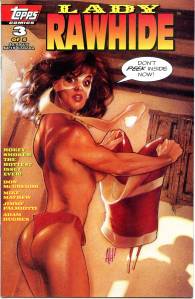
Lady Rawhide (1995)
Lady Rawhide is a scantily clad masked vigilante who defends the people from their oppression against tyrannical officials and other villains. She first appeared in Topps Zorro series, and later appeared in several solo one-shots and two mini-series. Lady Rawhide was created by Don McGregor and Mike Mayhew.
Anita Santiago was driven to create her own costumed identity to seek revenge against the Commandante of Los Angeles, Captain Enrique Monasterio who inflected terrible injures on her brother, Roman Santiago. Anita’s hatred for Zorro came about when her brother, Roman, was falsely mistaken as being Zorro by the nefarious Captain Enrique Monasterio who shot Roman point black which ended up permanently blinding Roman, and disfiguring left half of his face. Since then, Anita swore that she would make Zorro pay with his life.
What seemed like a simple task for vendetta became more complicated after she met her adversary that she eventually fell in love and came to respect what Zorro stood for. She would eventually adopt his goal to fight injustice and help the helpless against the wicked and corrupt.

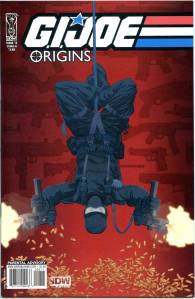
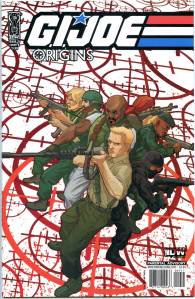
GI Joe: Origins (2009)
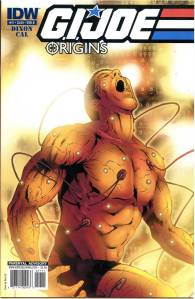
G.I. Joe: Origins is a 2009 series published by IDW Publishing. Originally conceived as a five-issue mini-series telling the story of G.I. Joe‘s first mission as a team, it subsequently became an ongoing series with rotating creative teams, featuring a mixture of both standalone character spotlight stories and tie-ins to the main ongoing series.
Many of the book’s standalone stories were originally intended for release as one-shot comics, much like IDW’s The Transformers: Spotlight, before being folded into Origins.
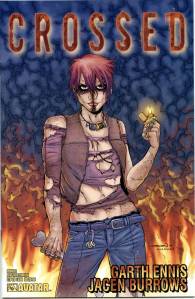
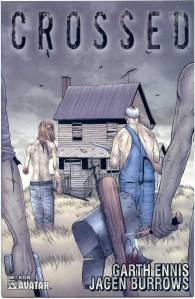
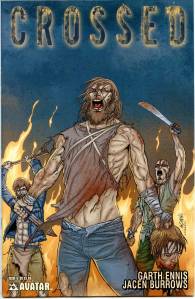
Crossed (2008)
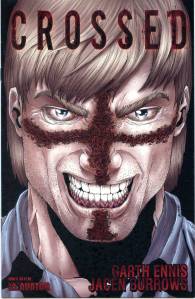
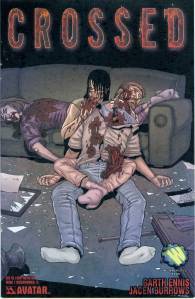
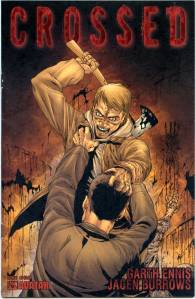
The story follows survivors dealing with a pandemic that causes its victims to carry out their most evil thoughts. Carriers of the virus are generally known as the “Crossed” due to a large, cross-like rash that appears on their faces – other names include “cross-faces” and “plus-faces”. This contagion is primarily spread through bodily fluids, which the Crossed have used to great effect by treating their weapons with their fluids, as well as through other forms of direct fluidic contact such as rape and bites, assuming the victim lives long enough to turn. A major difference between the Crossed and other fictional zombie or insanity-virus epidemics (e.g., in the film 28 Days Later) is that while the Crossed are turned into homicidal violent psychopaths, they still retain a basic human-level of intelligence: thus, they are still capable of using tools and weapons, driving motor vehicles, setting complex traps, and other actions. It is occasionally noted in the series that a Crossed retains any skills they had prior to their infection; most simply lack the patience or sanity to do anything not immediately related to their vicious impulses.
Cyberfrog – Harris (1996)
In an attempt to spead peace and knowledge throughout the universe, a plan was formed to send out unseeded energy masses to distant planets inside high technology living sentient robots, known as the Sinn. The Sinn was to be the ‘first parent’. On Earth, a human was to be the ‘second parent’.Aboard the vessel named Kjell Sinn was the energy mass named Trikk Rhan, the son of Sicha Rhan and his mate Kjell Rhan.
A crash landing on Earth in a swamp caused the energy mass to release early. As it leaked out, the Sinn was the first contact as planned. But the energy mass of Trikk Rhan came into contact with a bullfrog. The result was a surly hero who enjoys fried chicken, caffeine and violence.
Verotika (1994)
Verotika is an erotic horror anthology for mature audiences that attracted some of the best talent in the industry. Grant Morrison, Simon Bisley, and Frank Frazetta all worked on this anthology that offered creators the opportunity to unleash some of the most depraved, filthy, perverted and downright immoral stories ever told in comics. After every issue readers were left with the feeling that they needed to bathe in holy water.
Venus Domina (1996)
Venus Domina is not your ordinary Dominatrix. Her story is both bizarre and astounding. Duke Mighten provides
the interior art and a beautiful cover by Dave Stevens graces the first issue.