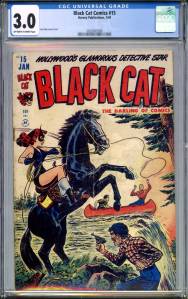
Black Cat (1948)

Linda Turner is the daughter of silent film Western actor Tim Turner, and a former Hollywood stunt woman. Linda has successfully made the transition from stunt woman to lead actress. During the filming of an unnamed picture, Linda suspects the film’s director, Garboil (no first name given), of being a Nazi spy or at the very least an American Bund member. In order to follow him and gain corroborating evidence, she disguises herself in a backless blue blouse, red shorts, blue flared gloves, red buccaneer boots and a blue opera mask and calls herself the Black Cat.

According to Jess Nevins’ Encyclopedia of Golden Age Superheroes, most of the Black Cat’s opponents are ordinary criminals and Axis agents, but she does fight a female mad scientist, the criminal brothers known as the Three Black Cats, a vampire, and after the war Russians in Afghanistan.

In 1944, The Black Cat’s costume was modified slightly, becoming a one piece blue bathing suit with buccaneer boots, flared gloves and opera mask, all in blue, and a red belt. This look would remain for the rest of her career.
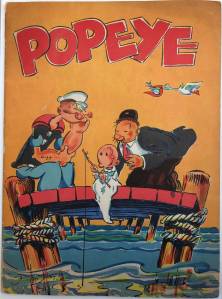
Popeye (1936)

Popeye Story book published in 1936 by King Features. Full color, oversized format 9 1/4-in. x 13-in. Bound in linen-like material. Published before the Feature Book series

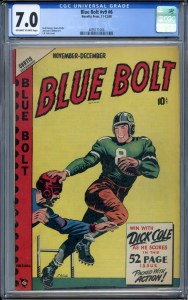
Blue Bolt V9 (1948)

After college football star Fred Parrish is struck by lightning during practice he boards a plane in order to seek help. This plane is struck by a second lightning bolt, causing the plane to crash. Finding himself underground, Parrish is found by a scientist named Bertoff who heals him using an experimental radium treatment. This treatment gives Parrish super powers. Using his powers and a lightning gun given to him by Bertoff, Parrish takes up the name the Blue Bolt and battles the underground forces of his arch-enemy, the evil Green Sorceress.

After a year, the Blue Bolt discovers that World War II has started. He journeys back to the surface to fight against the Nazis.

After the war, Blue Bolt becomes a pilot for Glimpses, the picture magazine, and works with daring photographer Snap Doodle.

Woody Woodpecker (1953)

Walter Lantz Woody Woodpecker became an independent comic book (starting with issue #16 to reflect the earlier appearances in Four Color) in Dec. 1952-Jan. 1953. It ran for 201 issues, published by Dell and then Western Publishing (Whitman/Gold Key), lasting until 1983.

Tweety and Sylvester (1952)

Dell was the first publisher of the Looney Tunes comic books, starting in 1941 and lasting until 1962, with a total of 246 issues published. Dell also made other comics based on the Looney Tunes characters including Bugs BunnyDaffy DuckTweety and Sylvester, etc. All Looney Tunes publications stopped in 1962, moving over to Gold Key Comics instead. The Looney Tunes title itself took a hiatus till 1975, but the character-based titles continued.

Tweety and Sylvester #10 F $9

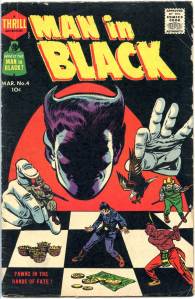
Man in Black (1958)

Stories and art by Bob Powell and others. Cover by Bob Powell. The Man in Black tells strange stories, sometimes intervening in person, other times merely letting ironic fate unfold. Fate prevents peace talks between the US and the Apache on the eve of Custer’s Last Stand. Cupid and Venus discover a kiss is the invitation to doom for two people. An unhappy janitor risks his life to steal a valuable treasure. The first movie buff on the moon deals with incompatible formats. Ambush; Jims Eagle; The Thief; Treasure; The Old and the New; Movies on the Moon; How It Might Have Happened. Issue 4 is the final issue of the series.

Felix the Cat (1950)

Otto Messmer pursued the Sunday Felix comic strips until their discontinuance in 1943, when he began eleven years of writing and drawing Felix comic books for Dell Comics that were released every other month. Jack Mendelsohn was the ghostwriter of the Felix strip from 1948 to 1952. In 1954, Messmer retired from the Felix daily newspaper strips, and his assistant Joe Oriolo (the creator of Casper the Friendly Ghost) took over. The strip concluded in 1966.

Turok Son of Stone (Dell)

Turok, Son of Stone, was illustrated by Rex Maxon. The writer-creator credit for the characters of Turok and Andar is disputed, with historians citing Matthew H. Murphy, Gaylord Du Bois and Paul S. Newman as the feature’s earliest writers.

The Western Publishing version of Turok was a Pre-Columbian era Native American (identified as Mandan in the first issue, on page 21 and 32 of Dell Four Color #596) who, along with his brother, Andar, became trapped in an isolated canyon valley populated by dinosaurs, which they refer to in general as “hoppers”, “monsters” and more often than not, beginning in Dell issue number 9, page 35 as “honkers”, as well as by their most obvious characteristics (tyrannosaurs are called “runners”, pterosaurs are called “flyers”, velociraptors are “screamers”, plesiosaurs are “sea demons”, Triceratops are “rammers”, etc.). The Du Bois stories involve Turok and Andar seeking a way out of the canyon. Du Bois was influenced by his visits to Carlsbad CavernsNew Mexico and developed the “Lost Valley” from his visits to the area.

After two appearances in Four Color #596 and #656, the title ran 27 issues (#3–29) published by Dell Comics (1956–62); then issues #30–125 (1962–80) from Gold Key Comics; and finally issues #126–130 (1981–82) under Western’s Whitman Comics imprint.

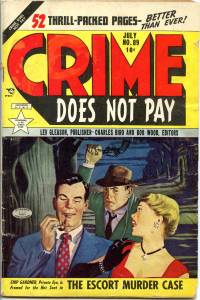
Crime Does Not Pay (1942)

Crime Does Not Pay was published between 1942 and 1955 by Lev Gleason Publications. Edited and chiefly written by Charles Biro, the title launched the crime comics genre and was the first “true crime” comic book series. At the height of its popularity, Crime Does Not Pay would claim a readership of six million on its covers. The series’ sensationalized recountings of the deeds of gangsters such as Baby Face Nelson and Machine Gun Kelly were illustrated by artists Bob WoodGeorge Tuska, and others. Stories were often introduced and commented upon by “Mr. Crime”, a ghoulish figure in a top hat, and the precursor of “horror hosts” such as EC Comics‘ Crypt Keeper. According to Gerard JonesCrime Does Not Pay was “the first nonhumor comic to rival the superheroes in sales, the first to open the comic book market to large numbers of late adolescent and young males.”

Shock SuspenStories (1952)

Shock SuspenStories was part of the EC Comics line in the early 1950s. The bi-monthly comic, published by Bill Gaines and edited by Al Feldstein, began with issue 1 in February/March 1952. Over a four-year span, it ran for 18 issues, ending with the December/January 1955 issue.

Front covers were by Feldstein, Wally WoodJohnny CraigGeorge Evans and Jack Kamen. Kamen was the comic’s most prolific artist, usually doing the lead eight-page story in each issue. Other stories were illustrated by Craig, Evans, Wood, Graham IngelsJack DavisAl WilliamsonJoe OrlandoReed CrandallBernard Krigstein and Frank Frazetta. Writing was handled by Gaines and Feldstein exclusively through the first 12 issues with the exception of a single story written by Craig. Over the last 6 issues other writers that contributed included Carl Wessler, Otto Binder, and Jack Oleck.

Issue 13 featured “Squeeze Play”, the only solo story Frank Frazetta drew for EC