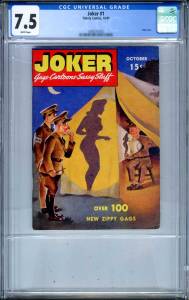
Stan Lee makes an appearance in the one-shot digest Joker, on three separate pages. (The only person to sign their text material.) This title would re-start shortly after as a large bedsheet (Life Magazine size) and run 4 more issues as Volume #1-4 on a quarterly basis. It will also concurrently become a comic book at the same time.
Titled simply Mystic and published by Marvel’s 1950s iteration, Atlas Comics, this was a 61-issue horror-suspense anthology (March 1951-Aug. 1957).
Mystic debuted shortly before Atlas’ Strange Tales, increasing the company’s science fiction/fantasy/horror line from four titles to six. Begun prior to the creation of the comic-book industry’s self-censorship board, the Comics Code Authority, Mystic softened its horror when it went under the auspices of the Comics Code beginning with issue #37 (May 1955). The series’ contributors included artists Bill Everett and John Severin.
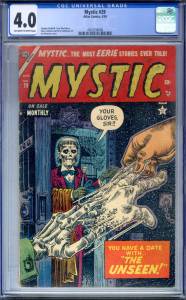
Mystic #29 CGC 4.0 Off-White to White Pages $225
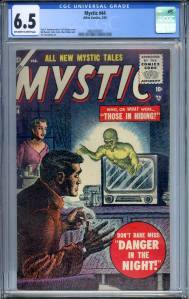
Mystic #44 CGC 6.5 Off-White to White Pages Blur $399
Panic was a bi-monthly humor comic that was published by Bill Gaines‘ EC Comics line during the mid-1950s as a companion to Harvey Kurtzman‘s Mad, which was being heavily imitated by other comic publishers.
Panic was edited by Al Feldstein (who became the editor of Mad a few years later). Beginning with its first issue (February–March 1954), Panic had a 12-issue run over two years. Feldstein was the primary cover artist, with stories illustrated by Jack Davis, Will Elder, Jack Kamen, Joe Orlando, Basil Wolverton and Wally Wood. Some story ideas were by Nick Meglin, later the co-editor of Mad. Scripts were by Feldstein, Elder and Jack Mendelsohn, later a co-screenwriter of Yellow Submarine (1968) and an Emmy-nominated TV comedy writer.
Murder Incorporated would’ve been an obvious title for a hard-hitting true-crime comic book in 1948. The real-life Murder Incorporated, the infamous hit squad of New York City organized crime had been shut down by the early 1940s, but their legend lived on in other media. This Fox Feature Syndicate series was true to its title as it featured true crime tales with a focus on mob killers and other notorious murderers. Murder Incorporated‘s notoriety was such that the series was mentioned by both Fredric Wertham in Seduction of the Innocent, and Geoffrey Wagner in Parade of Pleasure, and it landed on countless municipal government ban lists around the country in 1948, along with much of the rest of Victor Fox’s comic book line. An interesting series in the context of both comic book history and from a true-crime perspective.
Murder Incorporated #1 CGC 4.0 Off-White to White pages $495
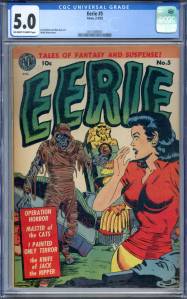
In 1951, Eerie #1, cover-dated May/June 1951, was published by Avon and saw a run of seventeen issues. The first issue of Eerie reprinted “The Strange Case of Henpecked Harry” from one-shot Eerie of 1947 as “The Subway Horror”, and issue 12 printed a Dracula story based on the Bram Stoker novel. Several covers featured large-breasted women in bondage. Artists Joe Orlando and Wallace Wood were associated with the series. The title saw a run of seventeen issues, ceasing publication with its August/September 1954 issue. Eerie then morphed into Strange Worlds with #18, October/November 1954.
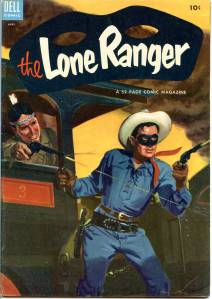
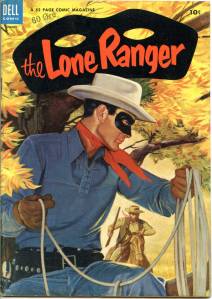
In 1948, Western Publishing, with its publishing partner Dell Comics, launched a comic book series which lasted 145 issues. This originally consisted of reprints from the newspaper strips (as had all previous comic book appearances of the character in various titles from David McKay Publications and from Dell). However, new stories by writer Paul S. Newman and artist Tom Gill began with issue #38 (August 1951). Some original content was presented as early as #7 (January 1949), but these were non-Lone Ranger fillers. Newman and Gill produced the series until its final issue, #145 (July 1962).
Tonto got his own spin-off title in 1951, which lasted 31 issues. Such was the Ranger’s popularity at the time that even his horse Silver had a comic book, The Lone Ranger’s Famous Horse Hi-Yo Silver, starting in 1952 and running 34 issues; writer Gaylord DuBois wrote and developed Silver as a hero in his own right. In addition, Dell also published three big Lone Ranger annuals, as well as an adaptation of the 1956 theatrical film.
The Dell series came to an end in 1962. Later that same year, Western Publishing ended its publishing partnership with Dell Comics and started up its own comic book imprint, Gold Key Comics. The new imprint launched its own Lone Ranger title in 1964. Initially reprinting material from the Dell run, original content did not begin until issue #22 in 1975, and the magazine itself folded with #28 in 1977. Additionally, Hemmets JournalAB published a three-part Swedish Lone Ranger story the same year.
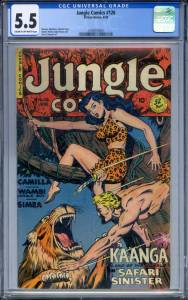
Having not been able to saturate the market’s insatiable demand for jungle sirens with Sheena in Jumbo Comics, Fiction House unleashed another series titled Jungle Comics. Running 163 issues staring January 1940 the series did not end until Fiction House succumbed to the Comics Code Authority over 14 years later.
Stories featured the main character Kaänga, a rather familiar sounding westerner child raised by apes. Another westerner, Ann Mason, became his mate after he rescued her from slave traders.
Jungle Comics #126 CGC 5.5 Cream to Off-White Pages $149
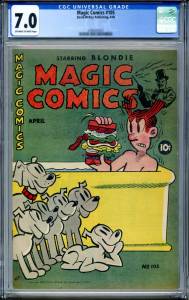
Magic Comics was published by David McKay Company from 1939 to 1949. The series was a compilation of newspaper strip reprints such as “Mandrake the Magician“, “Inspector Wade”, “Henry”, “Jan and Aloysius”, “Popeye”, “Secret Agent X-9”, “The Lone Ranger” and “Blondie”.
Magic Comics #105 CGC 7.0 Off-White to White Pages $129
Life Begins for Andy Panda is a 1939 American short subject cartoon created by Walter Lantz, as the very first Andy Panda film. The short capitalized on public interest surrounding the United States’ first captive panda, Su Lin, who had been donated to the Brookfield Zoo in Chicago three years earlier and whose arrival created a consumer desire for panda-related products.
Andy led a major part of his career in comic books, in Dell Comics‘ Crackajack Comics and New Funnies and his own series. One early Andy Panda comic book adventure was drawn by Carl Barks (New Funnies #76, 1943). John Stanley also did Andy Panda comic book work.
A companion series to Crime Does Not Pay from the same publisher, slightly less violent and with more emphasis on police work. Stories and art by Fred Kida, Dick Rockwell, Carl Wessler, Fred Guardineer, and Charles Biro.
Crime and Punishment #18 CGC 5.5 Off-White to White Pages $85





 EHT Comics