Step into the thrilling pages of Spellbound, a classic Atlas comics series that captivated readers in the 1950s. Through the expert craftsmanship of writer Sol Brodsky and talented artists, Spellbound brings to life unforgettable characters and stunning visuals that will linger in your mind long after you close the cover. Don’t miss out on this captivating series that defined the golden age of Atlas comics.
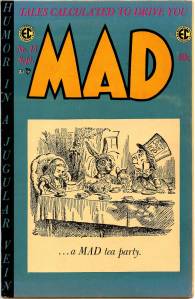
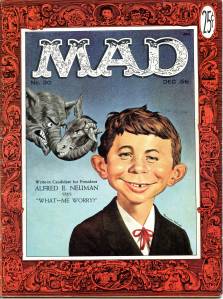
MAD is an American humor magazine founded in 1952 by editor Harvey Kurtzman and publisher William Gaines, launched as a comic book before it became a magazine. It was widely imitated and influential, affecting satirical media as well as the cultural landscape of the 20th century, with editor Al Feldstein increasing readership to more than two million during its 1974 circulation peak. As of January 2017, Mad has published 544 regular issues, as well as hundreds of reprint “Specials,” original material paperbacks, compilation books and other print projects.
mad #15 FN+ $150
Mad #30 (1956) 1st Full Alfred E. Neuman cover FN-VF $195
Whiz Comics #2 (cover-dated Feb. 1940) was published in late 1939. The comic’s lead feature introduced audiences to Billy Batson, an orphaned boy who, by speaking the name of the ancient wizard Shazam, is struck by a magic lightning bolt and transformed into the adult superhero Captain Marvel. Shazam’s name was an acronym derived from the six immortal elders who grant Captain Marvel his superpowers: Solomon, Hercules, Atlas, Zeus, Achilles and Mercury.
In addition to introducing the main character, his alter ego, and his mentor, Captain Marvel’s first adventure in Whiz Comics #2 also introduced his archenemy, the evil Doctor Sivana, and found Billy Batson talking his way into a job as an on-air radio reporter with station WHIZ. Captain Marvel was an instant success, with Whiz Comics #2 selling over 500,000 copies. By 1941, he had his own solo series, Captain Marvel Adventures, while he continued to appear in Whiz Comics, as well as periodic appearances in other Fawcett books, including Master Comics.
Captain Marvel Adventures #115 CGC 7.5 Off-White to White $495
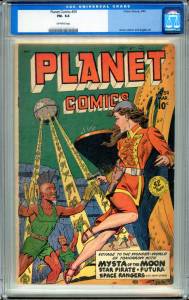
Planet Comics was a science fictioncomic book title published by Fiction House from January 1940 to Winter 1953. It was the first comic book dedicated wholly to science fiction. Like most of Fiction House’s early comics titles, Planet Comics was a spinoff of a pulp magazine, in this case Planet Stories. Like the magazine before it, Planet Comics features space operatic tales of muscular, heroic space adventurers who are quick with their “ray pistols” and always running into gorgeous women who need rescuing from bug-eyed space aliens or fiendish interstellar bad guys.
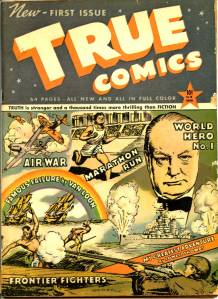
One of the first series of comics dedicated to educational topics was True Comics, published by Gworge J. Hecht’s Parents’ Magazine Press, beginning in 1941. Designed to convey not only information but also wholesome attitudes, the series covered a variety of materials, but many issues were devoted to patriotic stories from American history or to biographies of famous American (and occasionally non-Americans, such as Winston Churchill) from the past. The series also included stories of the exploits of the FBI, designed to heroize law enforcers and demonize criminal. These fact-based comics were enough of a commercial success that the series ran until 1950.
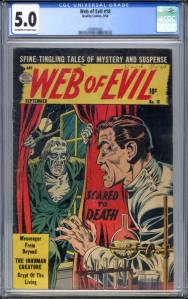
From the people who brought you Captain Marvel comes horror. Web of Evil was an anthology horror comic published by Quality Comics, and was acquired by DC Comics when DC bought Quality in 1956. It rivaled EC’s horror comics, often considered the measuring stick for greatness in this genre. With its smart writing, consistently high-end artwork, and willingness to push-the-envelope with its, violent, graphic depiction of scenes of the macabre, Web Of Evil, as with several EC horror titles, ended up getting Quality Comics in hot water, metaphorically.
Web of Evil #18 CGC 5.0 Off White – White Pages $299
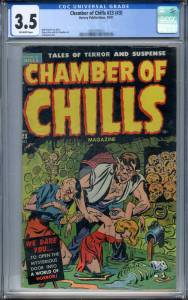
The first Chamber of Chills was a 10-cent horror anthology published bimonthly by Harvey Publications that ran 26 issues (cover-dated June 1951 – Dec. 1954).
Chamber of Chills was formerly Blondie Comics, taking over that comic’s numbering with issue #21. After issue #24 (Dec. 1951), the numbering was reset to #1. Chamber of Chills became Chamber of Clues with the February 1955 issue, and ceased publication two issues later, the last cover-dated April 1955.
Chamber of Chills #23 CGC 3.5 Off-White Pages $349
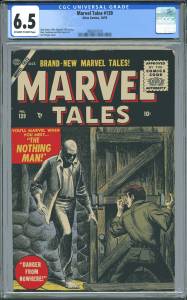
The first Marvel Tales was the direct continuation of the superhero anthology Marvel Mystery Comics, published by Marvel Comics‘ initial iteration, Timely Comics. This series ran through issue #92 (cover-dated June 1949). Beginning with issue #93 (Aug. 1949), it became Marvel Tales, an anthology of horror, fantasy, and science fiction stories. The bulk of this series was published under the company name Atlas Comics.
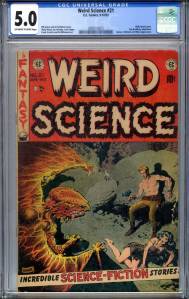
As with other EC Comics, Gaines and Feldstein used some Weird Science stories to teach moral lessons. “The Probers” (#8) features a space shuttle doctor who pays no mind to dissecting various animals, only to end up on an alien planet where aliens plan to dissect him. In “The Worm Turns” (#11) astronauts have fun with Mexican jumping beans but face a similar situation when they hide in a piece of fruit on an alien world and are found by a giant alien. “He Walked Among Us” (#13) was a take on organized religion in which a Christ-like astronaut helps the impoverished populace of an alien world but is killed by those in power, prompting the birth of a religion.
Gaines and Feldstein made cameo appearances in “Chewed Out” (#12), and other EC staffers were drawn into “EC Confidential” (#21).
Weird Science #21 CGC 5.0 Off-White to White Pages $489
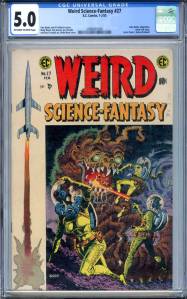
Weird Science Fantasy 27 CGC 5.0 Off White to White Pages $379
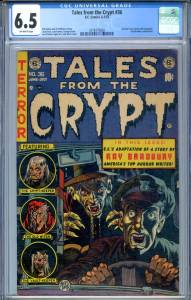
Tales from the Crypt was an American bi-monthly horror comic anthology series published by EC Comics from 1950 to 1955, producing 27 issues (the first issue with the title was #20, previously having been International Comics (#1–5); International Crime Patrol (#6); Crime Patrol (#7–16) and The Crypt of Terror (#17–19) for a total of 46 issues in the series). Along with its sister titles, The Haunt of Fear and The Vault of Horror, Tales from the Crypt was popular, but in the late 1940s and early 1950s comic books came under attack from parents, clergymen, schoolteachers and others who believed the books contributed to illiteracy and juvenile delinquency. In April and June 1954, highly publicized congressional subcommittee hearings on the effects of comic books upon children left the industry shaken. With the subsequent imposition of a highly restrictive Comics Code, EC Comics publisher Bill Gaines cancelled Tales from the Crypt and its two companion horror titles, along with the company’s remaining crime and science fiction series in September 1954.
Tales from the Crypt #36 CGC 6.5 Off-White Pages $1149


 EHT Comics