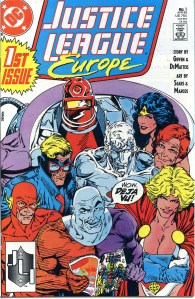
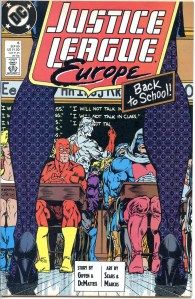
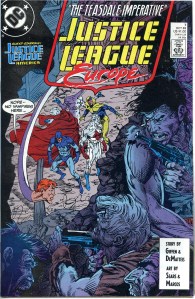
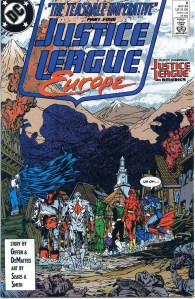
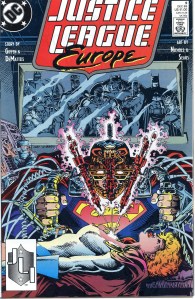
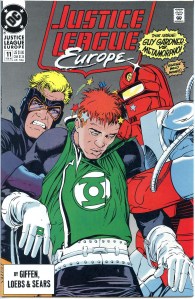
Justice League Europe (1989)

Justice League Europe was a DC Comics book run that was a spin-off of the comic book Justice League America (which was then named Justice League International (vol 1) for issues #7 to #25)

Justice League Europe was published for 68 issues (plus five annuals) from 1989 to 1994. Starting with issue #51 the title was renamed Justice League International (vol. 2). Like Justice League America, the series featured tongue-in-cheek humor but was a much more action-centric series than Justice League America. The action-themed nature of the series was most overt with the series’ most famous arc “The Extremists”. The arc featured the JLE fighting The Extremists, a cadre of psychopathic villains patterned after Marvel Comics villains Doctor Doom, Magneto, Doctor Octopus, Sabretooth and Dormammu.

The team was originally headquartered in Paris, France but later moved to an abandoned castle in Great Britain.

Legion of Super-Heroes V3 (1984)

The new series was launched in August 1984, with a five-part story featuring the Legion of Super-Villains. Giffen left in the middle of the story and was replaced by Steve Lightle, who stayed on the book for a year. The debut story arc saw the death of Karate Kid in issue #4. Levitz and Lightle co-created two Legionnaires, Tellus and Quislet, whose unusual appearances contrasted with the humanoid appearances of the other Legionnaires. Greg LaRocque began a lengthy run in #16, including a crossover with John Byrne‘s recently rebooted Superman titles in #37 and #38. The crossover was the first of several attempts by DC editors to explain the origins and fate of Superboy and his history with the Legion, in light of the revisions to the DC Universe caused by Crisis on Infinite Earths that removed Superman’s career as Superboy from his personal history. In the crossover, the Legion’s Superboy was revealed to have come from a parallel “pocket universe” created by the Time Trapper. The crossover ended with Superboy’s death. Levitz’s run ended with the return of Giffen and a four-part story “The Magic Wars”, concluding in #63 (August 1989).