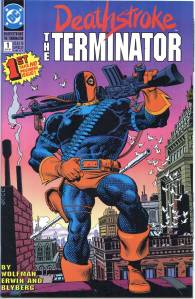
Deathstroke the Terminator first appeared in 1980, in the second issue of the book New Teen Titans. He was originally introduced as “the Terminator”, a mercenary who was completing the terms of a contract undertaken by his son Ravager and later in the series often allied with the Titans against mutual threats.
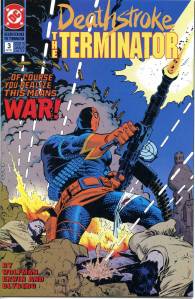
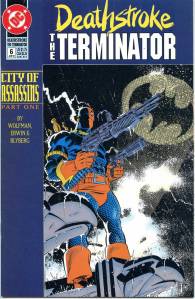
Due to his popularity, Deathstroke received his own series, Deathstroke the Terminator, in 1991. It was retitled Deathstroke the Hunted for issues #0 and #41-45; and then simply Deathstroke for issues #46-60. The series was cancelled with issue #60. In total, Deathstroke ran for 65 issues (#1-60, plus 4 annuals and a special #0 issue).
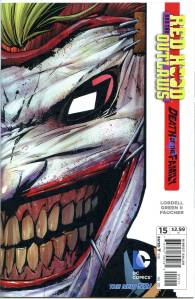
Commissioned in response to the growing popularity of the character of Jason Todd, a former protege of Batman who took a turn as a villain following his resurrection, the book depicts Jason’s continued adventures as the Red Hood, on a quest to seek redemption for his past crimes, forming a small team with two of his fellow anti-heroes.
Red Hood and the Outlaws debuted in 2011 as part of The New 52 event, which rebooted DC Comics continuity, creating a fresh jumping-on point for new readers. Writer Scott Lobdell chose to dial back Jason’s recent villainy for the character’s first starring book, pairing him with the characters of Arsenal (Roy Harper), and Starfire, and retroactively establishing a long friendship between Jason and Roy. The title also retold Jason Todd’s history in a simplified form, and explored his complex relationship with his former mentor Batman and his brothers (and fellow Robins) Dick Grayson, Tim Drake, and Damian Wayne. The series also debuted a new costume for Red Hood, drawing from previous iterations, featuring his classic biker helmet look but a clear Bat insignia on his chest, placing the Red Hood more emphatically in Batman’s family of supporting characters.
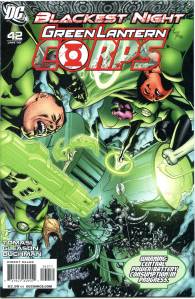
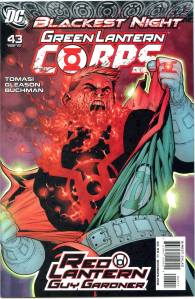
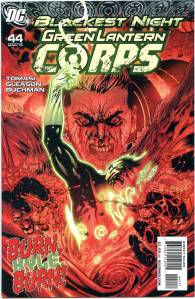
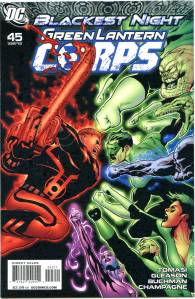
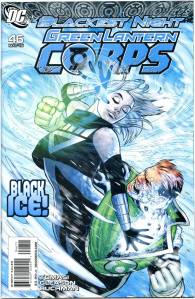
Hidden in the Book of Oa is the forbidden chapter of Cosmic Revelations, which contains a prophecy called the “Blackest Night”. In the prophecy, seven different colored corps are at war with each other, eventually destroying one another and the universe.
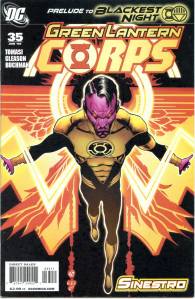
Following the Sinestro Corps War, Ganthet and Sayd are banished from the Guardians. Realizing that the “Blackest Night” prophecy will come to be, they create a blue ring powered by hope. The remaining Guardians create the Alpha-Lanterns and reveal new laws they’ve written to the Green Lantern Corps.
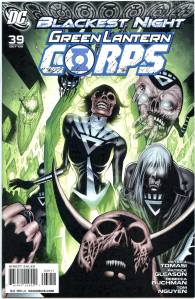
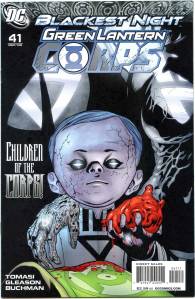
During the Blackest Night, the Guardians finally realize the accuracy of the prophecy and are imprisoned by Scar; a rogue Guardian who launches an attack on the Corps by reviving deceased members as Black Lanterns. Command falls to Guy Gardner, Kyle Rayner, and Salaak, a senior Lantern holding the rank of Clarissi.
The Green Lantern corps, along with the other six corps (The Sinestro Corps, the Red Lantern Corps, The Indigo Tribe, The Blue Lantern Corps, Agent Orange, and the Star Sapphires), fight the black lanterns to regain safety and order in the universe.
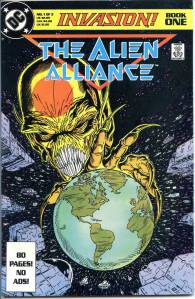
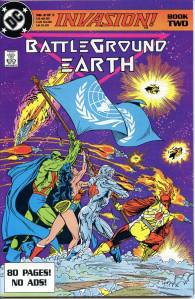
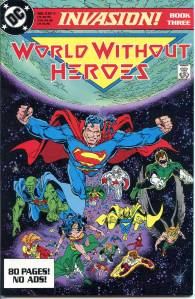
Invasion! was DC’s big crossover event for 1989. It crossed over into 30 other DC comics and also featured guest appearances from other DC Universe staples such as Adam Strange, the planet Thanagar, and one-time Justice League of America sidekick Snapper Carr and his team the Blasters. The Blasters would make several more appearances, fighting further alien threats to Earth.
The greatest impact of Invasion was its introduction of the metagene as the explanation within the DC Universe as to how some people gain superhuman abilities. The Flash’s father, Rudolph West (a Manhunter agent) appears to die in an explosion in Cuba, defending the land during Invasion #2. His subsequent returns would plague the Flash and his mother multiple times. Unusual for the time, the three issues were published as perfect-bound comics, each the length of three usual comics – a throwback to the “80-page giants” of the Silver Age.
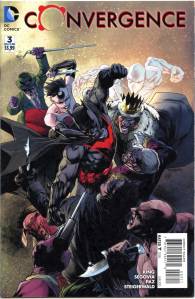
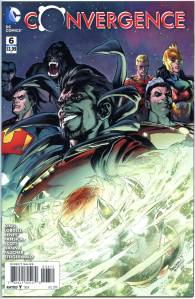
Convergence is a two-month weekly limited series, published by DC Comics, that ran from April 2015 to May 2015. Convergence spins out of the final issues of the weekly series, Earth 2: World’s End and The New 52: Futures End. The story involves Brainiac collecting cities and inhabitants from various timelines that have ended, trapping them in domes on a planet outside of time and space and opening them up to see what happens. Notable during this event is the return of DC characters and past timelines from before the 2011 “Flashpoint” storyline that led to the creation of The New 52 DC Universe.
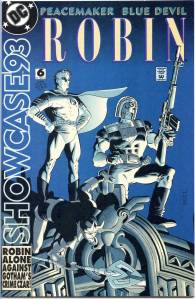
DC revived the Showcase title in 1993 when the 1950s retailer reluctance to order new, untested series had largely vanished, and was replaced in the 1990s with reader enthusiasm for the “#1” issues of new series. The new series was published as Showcase ’93, a monthly 12-issue miniseries, replaced yearly by Showcase ’94, ’95 and ’96, each one also a miniseries lasting 12 issues. Showcase ’96 #12 was the last issue.
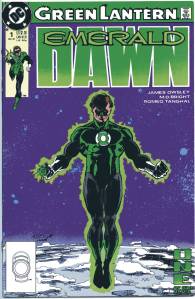
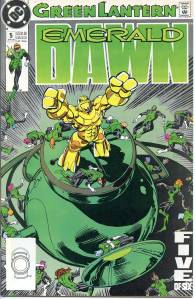
Green Lantern: Emerald Dawn is a 1989-1990 limited series. The series retold the origins of Hal Jordan and how he became a Green Lantern in post-Crisis continuity. It was created by Keith Giffen and Gerard Jones, with the first issue written by Jim Owsley.
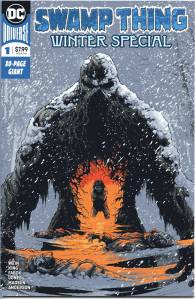
Tom King and Jason Fabok pay tribute to the legendary creators of Swamp Thing, writer Len Wein and artist Bernie Wrightson, as they join forces for an earth-shattering Swamp Thing passion project!
In this squarebound one-shot, Swamp Thing is out of his element as he shepherds a lost boy through a blinding blizzard and other hazards of a strange, frozen tundra. In this touching and harrowing tale of survival, the pair must navigate countless threats throughout a bewildering terrain—with a bloodthirsty snow monster hot on their heels. But how long can they rely on each other? Separated from the Green and stripped of his powers in this dead world, Swamp Thing struggles to fight for their lives and deliver the boy to safety. Disoriented and decaying, Swamp Thing’s fading understanding of his surroundings forces the duo to confront their desperation and uncover the true identity of the snow monster that hunts them.
In addition, this special features the final Swamp Thing story from the monster’s co-creator, Len Wein. Originally intended as the start of a new series, it is presented here both in its original script form and with art by Kelley Jones.













 EHT Comics