Doomsday: Year One (1995)

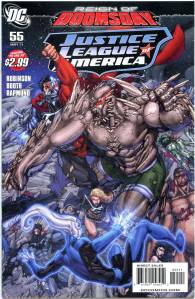
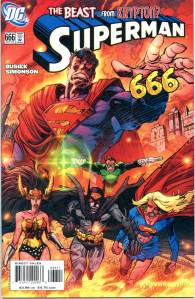
Doomsday: Year One is a 1995 comic book one-shot annual, which tells stories about the character of Doomsday. Thus far, it is the only comic book released which is entirely about Doomsday. In this issue, Doomsday meets Darkseid for the first time and fights the Green Lantern Corps.

Justice League of America V2 (2006)

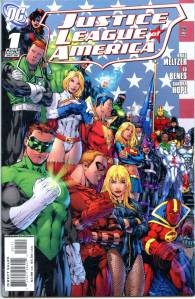
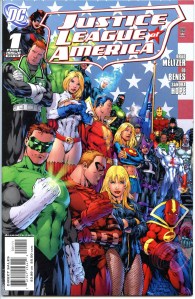
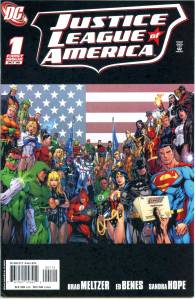
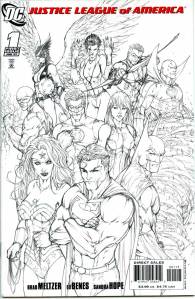
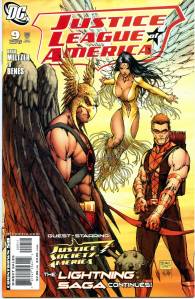
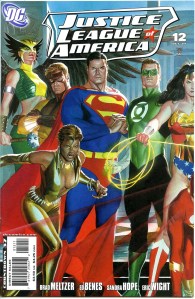
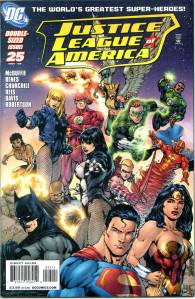
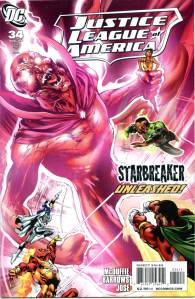
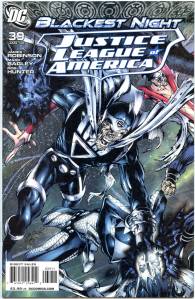
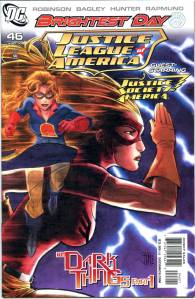
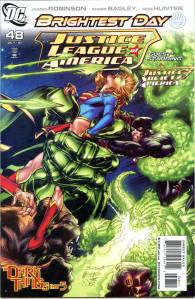
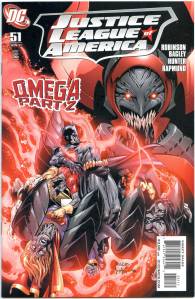
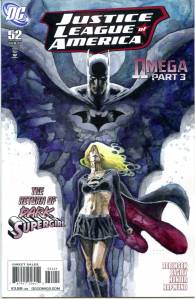
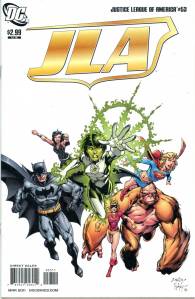
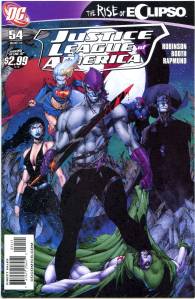
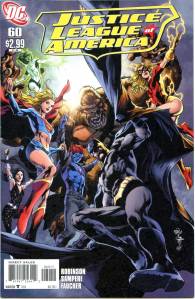
One year after the events of Infinite Crisis, Superman, Batman, and Wonder Woman reunite in the Batcave to re-form the League in Justice League of America #0, the kick-off for a new series by Brad Meltzer and Ed Benes. The series featured a roster which included Green Lantern (Hal Jordan), Black Canary, Red Arrow (Green Arrow‘s former sidekick), Red Tornado, Vixen, Black Lightning, and Hawkgirl. The first arc of the series focused upon Red Tornado and pitted the team against a new intelligent incarnation of Solomon Grundy and the rebuilt Amazo. The new incarnation of the team has two main headquarters, linked by a transporter. At the first site is The Hall, which in the mainstream DC Universe is a refurnished version of the Justice Society of America and the All-Star Squadron‘s former headquarters located in Washington, D.C.. Black Canary is elected as the first official Chairperson after the fight against Amazo and Solomon Grundy, and led both the Justice League and Justice Society in a complex quest to reunite time-lost members of the pre-Crisis Legion of Super-Heroes, who had been sent back in time to free both Bart Allen and Flash from the other dimensional realm of the Speed Force. Meltzer left the series at the end of issue #12, with one of his subplots (Per Degaton, a pre-nuclear fire mutation version of Despero, and a circa 1948 version of the Ultra-Humanite gathering for an unknown plot) resolved in the pages of Booster Gold.

Superman V1 (2000’s)

In the middle of 1999, the Superman titles relaunched with pretty much all new creators, and folks like Jerry Ordway, Louise Simonson and Dan Jurgens who had been working on the books for years moving on. That relaunch, which starts with Superman #151 by Jeph Loeb and Ed McGuinness more or less jettison most of the triangle era’s supporting cast, with a focus on more action and less character drama.

After Loeb moves on to Superman/Batman, we get a 12 issue run on Superman by Brian Azzarello and Jim Lee, Gail Simone takes over Action Comics for a year, with John Byrne on art, as all three Superman titles begin setting up the next major crossover, Infinite Crisis.
After Infinite Crisis, the DC Universe leap forward “One Year Later.” Geoff Johns and Kurt Busiek are the writers on Superman, starting off co-writing an 8 issue relaunch of the Superman titles. In the wake of Geoff Johns’ final storyline involving Brainiac, the Superman titles got intertwined again as a massive storyline spanning two years involving the creation of a New Krypton in Earth’s solar system, with SupergirlAction Comics, Superman, the World of New Krypton miniseries, several specials, all culminating in the “War of the Supermen” miniseries.
Impulse (1995)

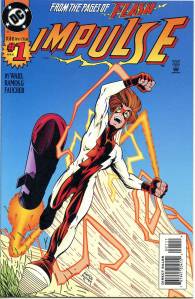
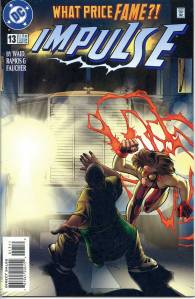
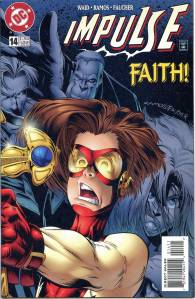
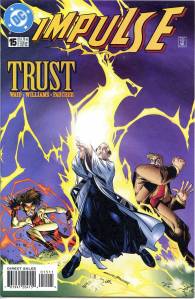
Suffering from a hyper-accelerated metabolism, Bart Allen was aging at a faster rate than that of any human being thus causing him to appear the physical age of twelve when he was chronologically, and mentally only two years old. To prevent him from developing mental health problems, he was raised in a virtual reality machine which created a simulated world that kept pace with his own scale of time. When it became clear that this method was not helping, his grandmother, Iris Allen, took him back in time to the present where The Flash, Wally West, tricked Bart into a race around the world. By forcing Bart into an extreme burst of speed, Wally managed to shock his hyper-metabolism back to normal. Because he had spent the majority of his childhood in a simulated world, Bart had no concept of danger and was prone to leaping before he looked. The youth proved to be more trouble than Wally could handle, and he was pawned off onto retired superhero speedster Max Mercury, who moved Bart to Manchester, Alabama. In Impulse #50, it was revealed that Batman actually named Bart “Impulse” as a warning, not a compliment.

JLA Classified (2005)

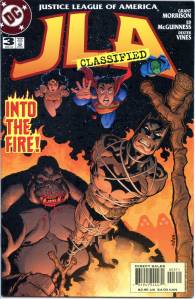
JLA: Classified is an anthology series which would feature rotating writers and artists producing self-contained story-arcs and aborted mini-series projects that were re-appropriated for publication within the pages of the series and starring the JLA. While the bulk of the stories took place within the continuity of the series (circa JLA #76–113) some of the stories take place outside of regular DC Universe canon.

Twas the Mite Before Christmas (2023)

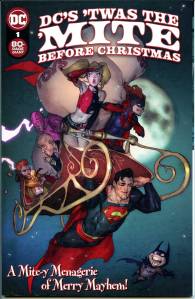
Join all your DC favorites as they take on eight classic holiday stories! From Constantine and Lex Luthor’s Dickensian tale to Batwoman’s puzzling Hanukkah hijinks to your classic cocoa-swilling Christmas romance switch with Harley and Amethyst, this book is a perfect companion for cookies by the fire and extra sour cream on your latkes.

Terminal City (1997)

The citizens in a retro-futuristic vision of the world of tomorrow struggle to come to terms with a variety of bizarre characters and their unusual schemes. Written by Dean Motter with art by Michael Lark.

Supergirl V5 (2005)

After the launch of the Superman/Batman comic book series, Executive Editor Dan DiDio had been looking for a way to simplify the Supergirl character from her convoluted post-crisis history; the simplest version of course, was Superman’s cousin. Jeph Loeb and editor Eddie Berganza found an opening to reintroduce the character following the conclusion of the first story arc of Superman/Batman.

The modern version of Kara Zor-El made her debut in Superman/Batman #8 (2004). Kara takes the mantle of Supergirl at the conclusion of the storyline. The Supergirl comic book series would later be relaunched, now starring Kara Zor-El as “The Girl of Steel”. The first arc of the new series was written by Jeph Loeb and illustrated by Ian Churchill.

Detective Comics (1980’s)

The title’s 500th issue (March 1981) featured stories by several well-known creators including television writer Alan Brennert and Walter B. Gibson best known for his work on the pulp fiction character The Shadow. Also used during the 1980s was the use of serialization of the main Batman story, with stories from Detective Comics and Batman directly flowing from one book to another, with cliffhangers at the end of each book’s monthly story that would be resolved in the other title of that month. A single writer handled both books during that time beginning with Gerry Conway and followed up by Doug Moench. The supervillain Killer Croc made a shadowy cameo in issue #523 (Feb. 1983). Noted author Harlan Ellison wrote the Batman story in issue #567.

Writer Mike W. Barr and artists Alan Davis and Todd McFarlane crafted the “Batman: Year Two” storyline in Detective Comics #575-578 which followed up on Frank Miller’sBatman: Year One“. Writer Alan Grant and artist Norm Breyfogle introduced the Ventriloquist in their first Batman story together and the Ratcatcher in their third (#585). Sam Hamm, who wrote the screenplay for Tim Burton‘s Batman, wrote the “Blind Justice” story in Detective Comics issues #598-600.

Soul Plumber (2021)

Edgar Wiggins, a disgraced former seminary student, is desperate to find a way to answer what he believes is his higher calling. He thinks hes found it in a seminar hosted in a hotel conference room by the Soul Plumbers, who have a machine that could be the secret to delivering souls from Satan. Edgars too broke to buy in, but thats not enough to stop this true devotee: he steals the blueprints and builds a pirated version with what components he can afford on his gas station attendant salary.  Then he goes after a demon, misses… and ends up pulling out something much worse.