Amazing Spider-Man reverted completely to its original numbering for #500 (Dec. 2003).Mike Deodato, Jr. penciled the series from mid-2004 until 2006. That year Peter Parker revealed his Spider-Man identity on live television in the company-crossover storyline “Civil War“, in which the superhero community is split over whether to conform to the federal government’s new Superhuman Registration Act. This knowledge was erased from the world with the event of the four-part, crossover story arc, “One More Day“, written partially by J. Michael Straczynski and illustrated by Joe Quesada, running through The Amazing Spider-Man #544-545 (Nov.-Dec. 2007), Friendly Neighborhood Spider-Man #24 (Nov. 2007) and The Sensational Spider-Man #41 (Dec. 2007), the final issues of those two titles. Here, the demonMephisto makes a Faustian bargain with Parker and Mary Jane, offering to save Parker’s dying Aunt May if the couple will allow their marriage to have never existed, rewriting that portion of their pasts. This story arc marked the end of Straczynski’s tenure as writer.
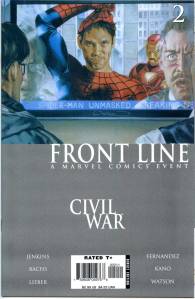
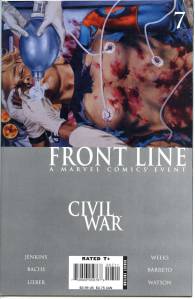
Part of the story is told from the perspective of two reporters embedded in the opposite camps of the war.Ben Urich follows the stories on Iron Man‘s side with the pro-registration heroes, while Sally Floyd investigates the anti-registration faction headed by Captain America. Writer Paul Jenkins was given carte blanche to have the stories reflect the current political landscape in the United States.
The other half of the series is told from the perspective of Speedball of the New Warriors. It shows Speedball’s struggles with survivor guilt, imprisonment, and relations to the victims of the Stamford disaster.
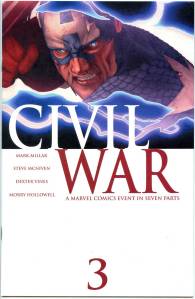
The plot of the series follows a framework story line in which the U.S. government passes a Superhero Registration Act, ostensibly designed to have super powered individuals act under official regulation, somewhat akin to law enforcement. However, superheroes opposed to the act, led by Captain America, find themselves in conflict with those supporting the act, led by Iron Man, with Spider-Man caught in the middle; the X-Men take a neutral stance. The superheroes in support of the law, such as Iron Man, Mister Fantastic and Ms. Marvel, become increasingly authoritarian. The conflict between freedom and security is an underlying theme in the story line, with real-life events and discussions, such as the U.S. government’s increased surveillance of its citizens, serving as a backdrop for the events in Civil War. A sequel, Civil War II, debuted in June 2016.
Civil War is encompassing the entire Marvel Universe and the effects of the war are being felt by every hero, villain, and civilian. Civil War: Choosing Sides One-Shot features five stories that shine a spotlight on the wildcards and impact players whose part in the Civil War has yet to be told, including Daredevil/Iron Fist, U.S. Agent, the Irredeemable Ant Man, Venom, and even…Howard the Duck!?








 EHT Comics